


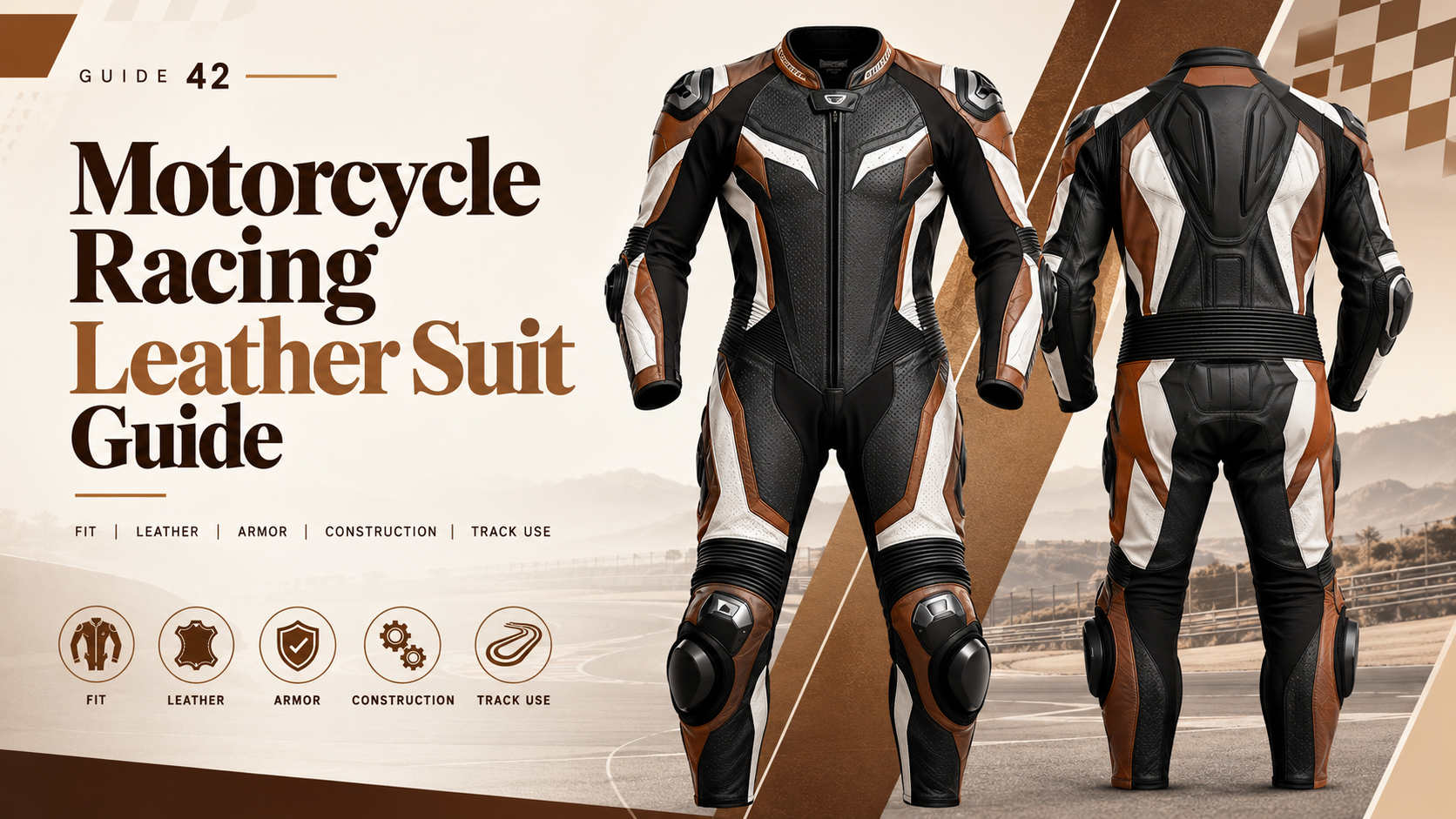
Motorcycle Racing Leather Suit Guide
A motorcycle racing leather suit is built around the demands of performance riding. This guide explains the fit, leather construction, protective-component compatibility, stretch zones, closures, ventilation and other construction details worth examining before choosing a racing suit.
What Makes a Motorcycle Racing Suit Different?
A motorcycle racing suit is designed around the rider’s performance position rather than ordinary standing posture. Its leather panels, articulated patterning, stretch zones, protective-component pockets and closures are intended to work together as one garment.
For that reason, evaluating a racing suit means looking beyond the outer appearance. The material, construction, fit and intended riding environment all form part of the complete garment.
When evaluating a motorcycle racing suit, examine the riding-position fit, leather construction, reinforced areas, armor compatibility, stretch zones, closures, ventilation and intended use.
One-Piece vs Two-Piece Racing Suits
Motorcycle racing suits are available in different configurations. One-piece and two-piece designs should be considered according to intended use, construction, connection system, mobility and overall fit.
One-Piece Racing Suit
A one-piece suit integrates the jacket and trousers into a continuous garment. This configuration is commonly associated with dedicated racing and track-oriented use.
- Continuous upper and lower construction
- Close athletic racing fit
- Pre-curved arms and legs
- Designed around riding posture
- Integrated racing construction
Two-Piece Racing Suit
A two-piece design uses separate jacket and trousers intended to work together. The connection system and complete-set fit are important when evaluating this configuration.
- Separate jacket and trousers
- Convenient two-piece configuration
- Jacket-to-pants connection is important
- Complete-set fit should be checked
- Intended use depends on the design
What Leather Should a Racing Suit Use?
Leather selection is one part of racing-suit construction. The complete garment should also be evaluated for panel layout, articulation, reinforcement, stretch zones, seam construction and protective-component compatibility.
Premium Milled Cowhide
The racing-suit specification used for this guide identifies premium milled cowhide leather with a target thickness of 1.2–1.3 mm for the main shell. Selected articulation and comfort areas use a secondary cowhide specification of 1.0–1.2 mm.
| Area | Specification | Construction Role |
|---|---|---|
| Main Leather | Premium milled cowhide, 1.2–1.3 mm target. | Primary leather shell. |
| Secondary Leather | Cowhide, 1.0–1.2 mm in selected articulation and comfort areas. | Selected movement and comfort zones. |
| Stretch | High-abrasion 4-way stretch textile. | Controlled mobility. |
| Lining | Breathable polyester mesh. | Internal comfort and airflow. |
| Thread | Bonded high-tenacity polyester/nylon. | Garment seam construction. |
How Should a Motorcycle Racing Suit Fit?
Racing-suit fit should be assessed in the riding position. A garment can feel very different while standing compared with sitting on a motorcycle with bent arms, knees and a forward-leaning torso.
Important Fit Areas
Armor Pockets and Protective Components
The racing-suit specification provides CE-compatible armor pockets for the shoulders, elbows, knees, hips and back. The exact armor specification still needs to be selected and tested for the final garment.
Shoulders
Shoulder armor pocket positioning should be checked for compatibility with the intended protective component.
Elbows
Elbow protection should align with the articulated sleeve construction.
Knees
Knee armor and slider placement should work with the articulated leg pattern.
Hips
Hip-protection compatibility should be considered when evaluating the complete suit.
Back
The design includes compatibility for a dedicated back-protector pocket.
Chest
Chest-protector compatibility should be confirmed according to the final garment design.
A manufacturing specification is not itself a certification document. Protective performance should be validated on the final production garment against the standards required for the target market.
Why Racing Suits Use Stretch Panels
A race-oriented suit needs controlled mobility because the rider changes position continuously. The technical specification places high-abrasion 4-way stretch textile at selected areas including the back, crotch, underarms and knees.
Closures, Ventilation and Race Hardware
Heavy-Duty Closure
The specification calls for a heavy-duty YKK or equivalent motorcycle-rated front-center zipper.
- Motorcycle-rated zipper construction
- Central front closure
- Designed for repeated use
Ventilation
Ventilation can be integrated through laser/perforated leather zones and/or zip vents.
- Perforated leather zones
- Zip ventilation where specified
- Breathable internal mesh lining
Knee Sliders
The specification includes replaceable knee sliders, with optional elbow sliders.
- Replaceable knee sliders
- Optional elbow sliders
- Positioning should match the final pattern
Aerodynamic Construction
The technical design includes an aerodynamic hump together with back-protection and mobility zones.
- Aerodynamic hump
- Shoulder-blade mobility
- Lower-back stretch
Reinforced Panels and Seam Construction
A racing suit is made from multiple panels rather than a single continuous piece of leather. The technical specification identifies race-grade leather panels, reinforced seams and selected mobility areas.
Look at the quality and consistency of the leather panels, seam construction, articulation zones, seat and crotch reinforcement and areas around protective components.
Choosing a Suit for Track and Performance Riding
The technical specification identifies the suit’s primary use as track and performance motorcycle riding. The appropriate garment should therefore be evaluated according to its actual riding environment and construction.
| Consideration | What to Check | Why It Matters |
|---|---|---|
| Riding Position | Check the garment while sitting in the intended motorcycle position. | Racing patterns are designed around articulated riding posture. |
| Protection | Confirm compatible protective components and their placement. | Pocket position and compatibility affect the complete garment system. |
| Mobility | Examine back, crotch, underarm and knee stretch areas. | These zones support controlled movement. |
| Ventilation | Check perforated leather and/or zip vents. | Ventilation design affects practical riding comfort. |
| Closures | Inspect the main zipper and other closure points. | Closures are important parts of garment construction and usability. |
What to Check Before Buying a Racing Suit
Use this checklist to evaluate a motorcycle racing leather suit as a complete garment rather than judging it from appearance alone.
Motorcycle Racing Leather Suit FAQ
What is a motorcycle racing leather suit?
What is the difference between a one-piece and two-piece racing suit?
What leather thickness is specified for this racing suit?
Where are stretch panels used in the racing suit?
What armor locations are included?
Does a manufacturing specification prove certification?
Why does a racing suit need an articulated fit?
What should I check before buying a racing suit?
Look at the Complete Racing Suit, Not Just the Leather
A quality racing suit is a complete construction system. Leather, articulated fit, reinforced panels, stretch zones, protective-component compatibility, closures, ventilation and intended riding use should all be considered together.