


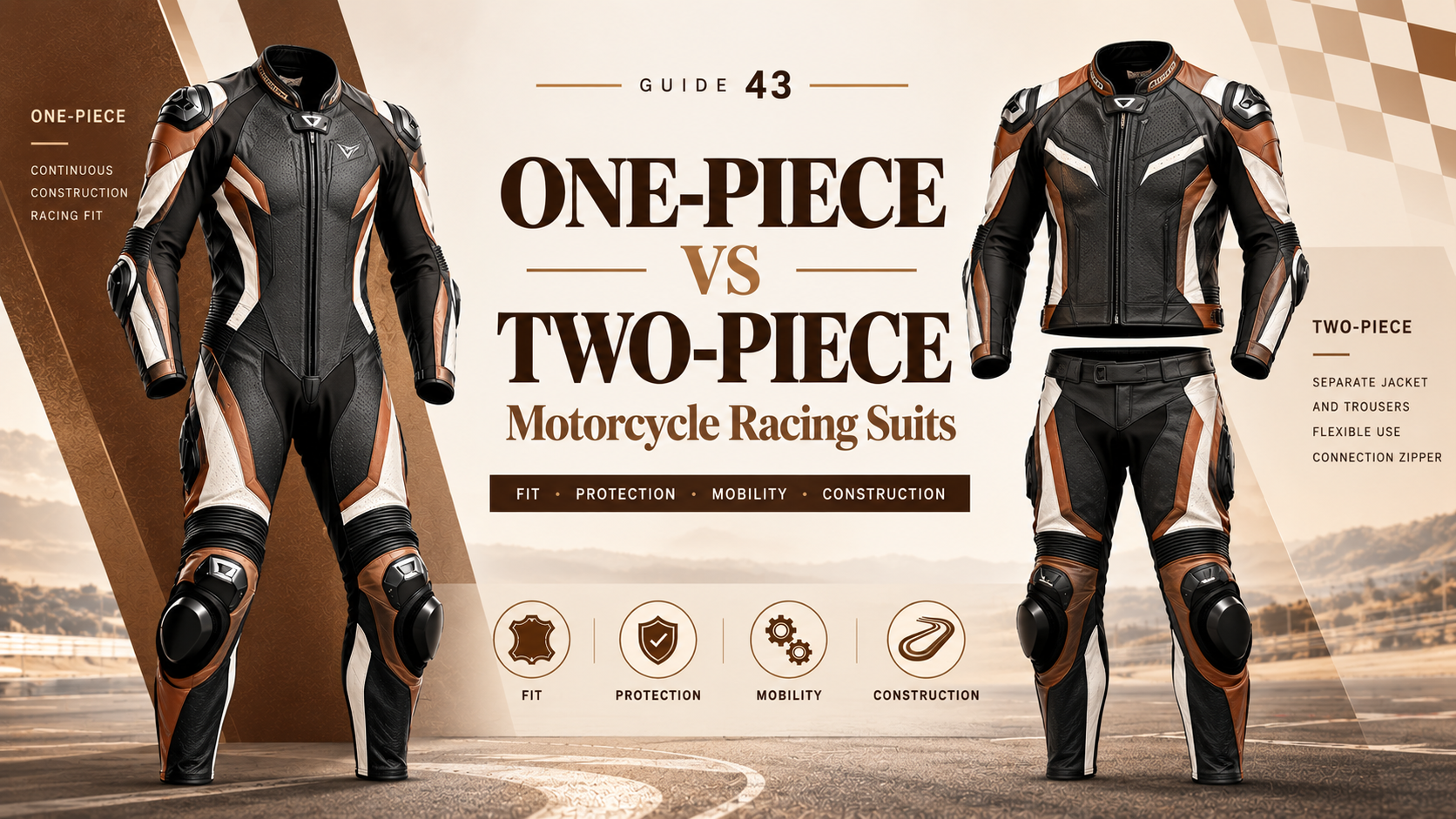
One-Piece vs Two-Piece Racing Suit
One-piece and two-piece motorcycle racing suits are built for different riding needs and configurations. Learn how they differ in construction, fit, connection, mobility, protection and practical use.
What Is the Difference?
The primary difference is how the upper and lower portions of the garment are constructed. A one-piece racing suit combines the jacket and trousers into one continuous garment, while a two-piece racing suit uses separate pieces designed to function as a complete set.
The choice should be evaluated by looking at the garment’s intended use, riding position, fit, connection system, protective construction and practical requirements.
A one-piece suit provides continuous jacket-to- trouser construction, while a two-piece suit separates the upper and lower garments. The better configuration depends on the specific design and intended riding use.
Understanding Both Racing Suit Types
Both configurations can be designed for motorcycle riding. The important point is to evaluate the actual construction rather than assuming that every suit in the same category has identical characteristics.
One-Piece Racing Suit
A one-piece suit integrates the jacket and trousers into a single garment. The pattern can be designed around an aggressive riding posture with continuous construction between the upper and lower sections.
Two-Piece Racing Suit
A two-piece suit consists of a separate jacket and trousers. When intended to operate as a complete racing system, the two sections use a connection mechanism such as a jacket-to- pants zipper.
One-Piece vs Two-Piece at a Glance
| Feature | One-Piece | Two-Piece |
|---|---|---|
| Construction | Upper and lower sections form one continuous garment. | Separate jacket and trousers. |
| Riding Position | Pattern can be developed specifically around a racing posture. | Jacket and trousers should both fit correctly in the riding position. |
| Connection | No separate jacket-to-pants connection is required. | A suitable connection zipper or system may join the two garments. |
| Convenience | Requires putting on one complete suit. | Separate pieces can be more practical for some riding situations. |
| Mobility | Continuous garment construction. | Depends on the design and connection system. |
| Storage | One larger garment. | Two separate pieces. |
| Evaluation | Assess the complete suit as one garment. | Assess jacket, trousers and their connection together. |
Where Each Configuration Fits
The configuration should be matched to the type of riding and the design of the actual garment.
Dedicated Track Riding
A one-piece configuration is commonly associated with dedicated racing and track-oriented garments, particularly when the complete suit is built around an aggressive riding posture.
Performance Riding
Both configurations can be designed for performance riding. Fit, leather construction, protection and mobility should be evaluated.
Flexible Riding
A two-piece configuration provides separate upper and lower garments, which can be useful when the design prioritizes flexibility between pieces.
How Fit Changes Between the Two
Racing suits should be evaluated in the motorcycle riding position rather than only while standing. Arms, shoulders, hips and knees change position when the rider is seated and leaning forward.
One-Piece Fit
- Entire garment should work together.
- Back length should accommodate the riding position.
- Sleeves should remain correctly positioned with bent arms.
- Knee and hip articulation should align with the motorcycle position.
- Stretch zones should allow controlled movement.
Two-Piece Fit
- Jacket and trousers must each fit correctly.
- The waist connection should remain secure.
- Jacket length should work with the trousers.
- The connection system should not restrict riding movement.
- Both pieces should maintain correct protective-component positioning.
Why the Jacket-to-Pants Connection Matters
On a two-piece racing suit, the connection between the jacket and trousers is an important part of the complete garment. A zipper or equivalent connection system should be compatible with the design of both pieces.
Check the Complete Connection
Inspect how the jacket and trousers connect, where the connection sits on the body and whether the system works correctly while the rider is in the intended riding position.
Protection Should Be Evaluated Separately
The number of pieces does not by itself describe the protective performance of a racing suit. The actual protective components, pockets, placement, leather construction and certification should be evaluated separately.
Shoulders
Check armor compatibility and positioning.
Elbows
Confirm protection aligns with the sleeve.
Knees
Check knee armor and slider positioning.
Back
Verify compatibility with the intended back protector.
A one-piece or two-piece configuration does not automatically establish certification or protective performance. Check the actual garment’s documented specifications and applicable certification.
Advantages and Considerations
One-Piece Considerations
- Continuous upper and lower construction.
- Purpose-built racing pattern can work as one integrated garment.
- No separate jacket-to-pants connection is required.
- Common configuration for dedicated track racing garments.
Two-Piece Considerations
- Separate jacket and trousers.
- Connection system becomes part of the complete garment.
- Jacket and trousers must be evaluated together for fit.
- Can provide a more flexible two-piece configuration depending on design.
What Should You Check Before Buying?
One-Piece vs Two-Piece Racing Suit FAQ
What is a one-piece motorcycle racing suit?
What is a two-piece motorcycle racing suit?
Are one-piece suits only for racing?
Why does a two-piece racing suit need a zipper?
Which suit has better protection?
Can a two-piece suit be used for performance riding?
Should a racing suit be fitted while standing?
Compare the Complete Garment, Not Just the Number of Pieces
The key difference between one-piece and two-piece racing suits is their construction. When choosing between them, evaluate the actual suit’s fit, leather, mobility, protection, connection system and intended riding use.