


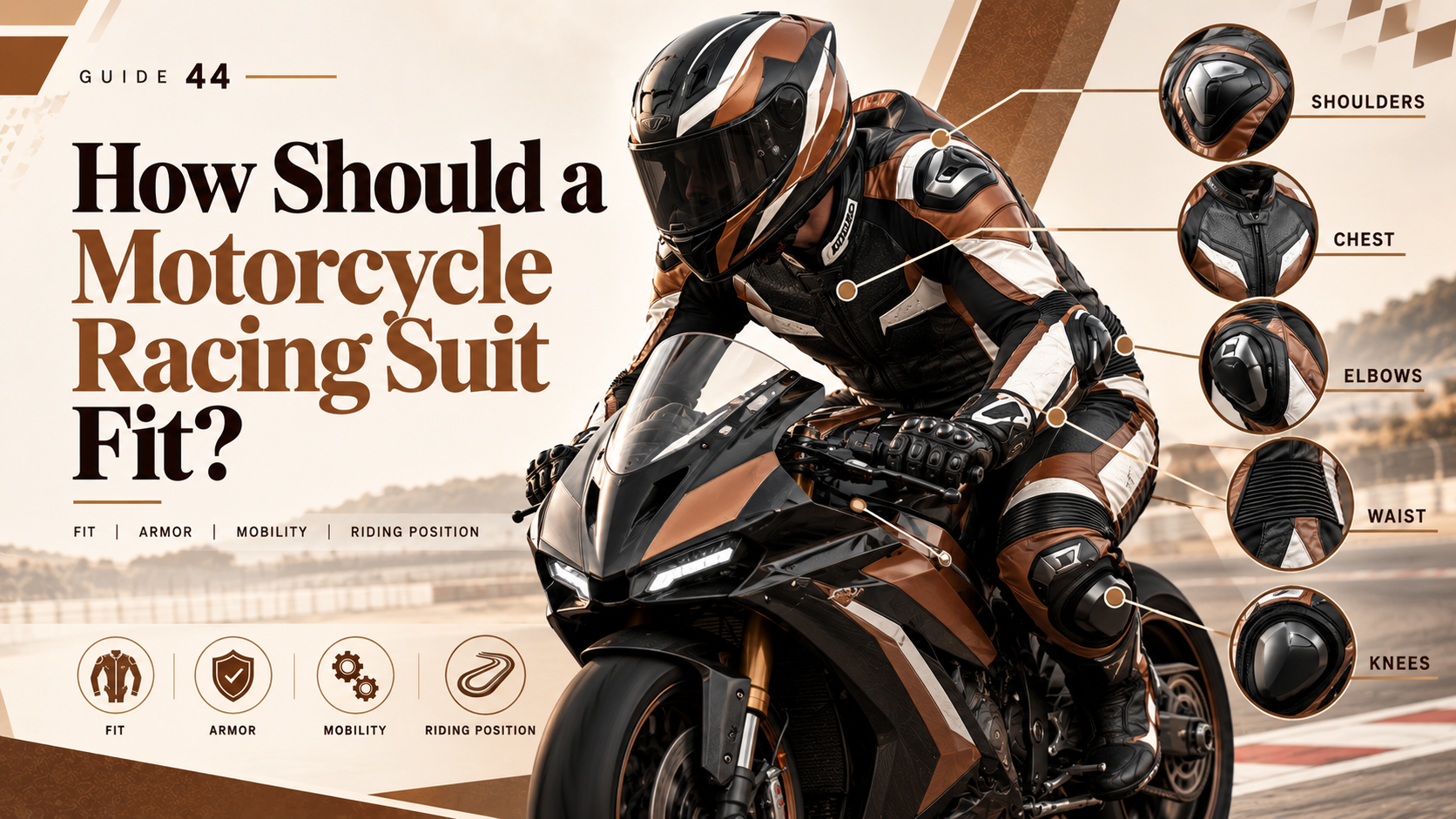
How Should a Motorcycle Racing Suit Fit?
A racing suit should fit closely without restricting the rider’s movement. Learn how to evaluate the shoulders, chest, sleeves, waist, hips, knees, armor positioning and overall fit in the riding position.
What Should a Racing Suit Feel Like?
A motorcycle racing suit should fit closely around the rider’s body while allowing the rider to adopt the intended motorcycle riding position. It should not hang loosely like casual clothing, but it should also not create excessive pressure that interferes with movement.
The most important point is that racing suits should be evaluated while sitting in the riding position. A suit that feels different while standing may behave differently when the arms, shoulders, hips and knees are bent.
The correct racing-suit fit is close and supportive, with enough articulation and stretch to allow the rider to move naturally. Armor should remain correctly positioned while the suit should not create excessive pressure, loose folds or restricted movement.
Close-fitting does not mean painfully tight.
The suit should follow the rider’s body and remain correctly positioned during movement, while the construction should provide sufficient room for the rider to adopt the intended riding posture.
Check These Areas Carefully
Instead of judging the entire suit from one area, check each major body zone individually. The fit of the shoulders, torso, sleeves, waist, hips and legs all contribute to how the complete suit performs.
Shoulder Fit
The shoulder area should sit correctly over the rider’s shoulders. Excessive looseness can allow the garment and protective components to move away from their intended positions.
Chest & Torso
The chest should feel secure without creating excessive compression. When the rider leans forward, the torso should continue to provide enough room for natural breathing and movement.
Sleeve Length
Sleeves should remain appropriately positioned when the arms are bent. Racing patterns commonly use pre-curved sleeves to accommodate the riding position.
Waist Area
The waist should remain secure without excessive pressure. On two-piece suits, the jacket and trousers should work together correctly around the waist.
Hip & Seat
The hip area should allow the rider to sit naturally on the motorcycle. Excess material should not interfere with movement or create uncomfortable pressure.
Knee Position
Knee armor and any knee sliders should align correctly with the rider’s knees when seated in the riding position.
Fit Is a Balance Between Four Things
A good racing suit needs to balance close body contact with movement, protective-component placement and the riding posture for which the suit was designed.
Test the Suit in the Riding Position
Standing in front of a mirror is not enough to evaluate a racing suit. Motorcycle racing suits are shaped around a riding posture, so the rider should check how the garment behaves when seated on the motorcycle.
Bend. Reach. Sit. Move.
Sit in the normal riding position and check the shoulders, elbows, back, waist, hips and knees. The suit should allow the rider to reach the handlebars without creating excessive tension across the shoulders or back.
Also check whether the knee and elbow protection remains correctly positioned as the limbs bend.
Armor Should Stay Where It Is Intended
Fit is also important because protective components are designed to occupy specific positions on the body. A suit that is excessively loose may allow components to move away from their intended locations.
Stretch Panels Are Part of the Fit
A properly fitted racing suit is not simply made smaller until it feels tight. Motorcycle racing garments use articulated construction and stretch areas to provide controlled movement around the shoulders, lower back, elbows, knees and other high-movement areas.
Back Stretch
Stretch material or accordion panels can help accommodate the forward-leaning riding position and movement around the torso.
Elbow Articulation
Pre-curved sleeves and stretch areas can help the sleeve follow the rider’s bent arm.
Knee Movement
Articulated knee construction should allow the rider to bend the leg without excessive tension.
Shoulder Mobility
The upper body should allow the rider to reach the handlebars without excessive pulling across the shoulders.
Signs the Suit May Not Fit Correctly
Excessive Pressure
Strong pressure around the chest, shoulders, waist or thighs can indicate that the garment is too restrictive.
Excess Material
Large loose areas or excessive folds can indicate that the suit is too large in that particular zone.
Moving Armor
Protective components that move significantly away from their intended positions deserve particular attention.
Restricted Arms
Difficulty reaching the handlebars or excessive pulling across the shoulders can indicate poor fit.
Knee Misalignment
Knee protection that sits noticeably away from the knees should be checked before riding.
Poor Riding Posture
If the suit makes the normal riding position uncomfortable, its size or pattern may need further evaluation.
Motorcycle Racing Suit Fit Checklist
Check the Garment
- Confirm the suit’s intended riding use.
- Check leather thickness and construction.
- Examine the protective components.
- Check stretch and articulation zones.
- Review ventilation and lining.
Check the Fit
- Test the suit while standing.
- Sit in the motorcycle riding position.
- Check shoulder and elbow movement.
- Check knee and hip alignment.
- Confirm armor remains correctly positioned.
Fit alone does not establish protective performance. Always check the actual product specifications, protective components and applicable certification information for the specific racing suit.
Motorcycle Racing Suit Fit FAQ
Should a motorcycle racing suit be tight?
How tight should a leather racing suit be?
Should a racing suit have wrinkles?
Should I try a racing suit while sitting?
Where should motorcycle suit armor sit?
How should racing suit sleeves fit?
How should racing suit pants fit?
Can a racing suit stretch over time?
The Right Fit Moves With the Rider
A motorcycle racing suit should fit close to the body, keep protective components correctly positioned and provide enough articulation for the intended riding posture. Always evaluate the complete garment while seated in the motorcycle riding position.