


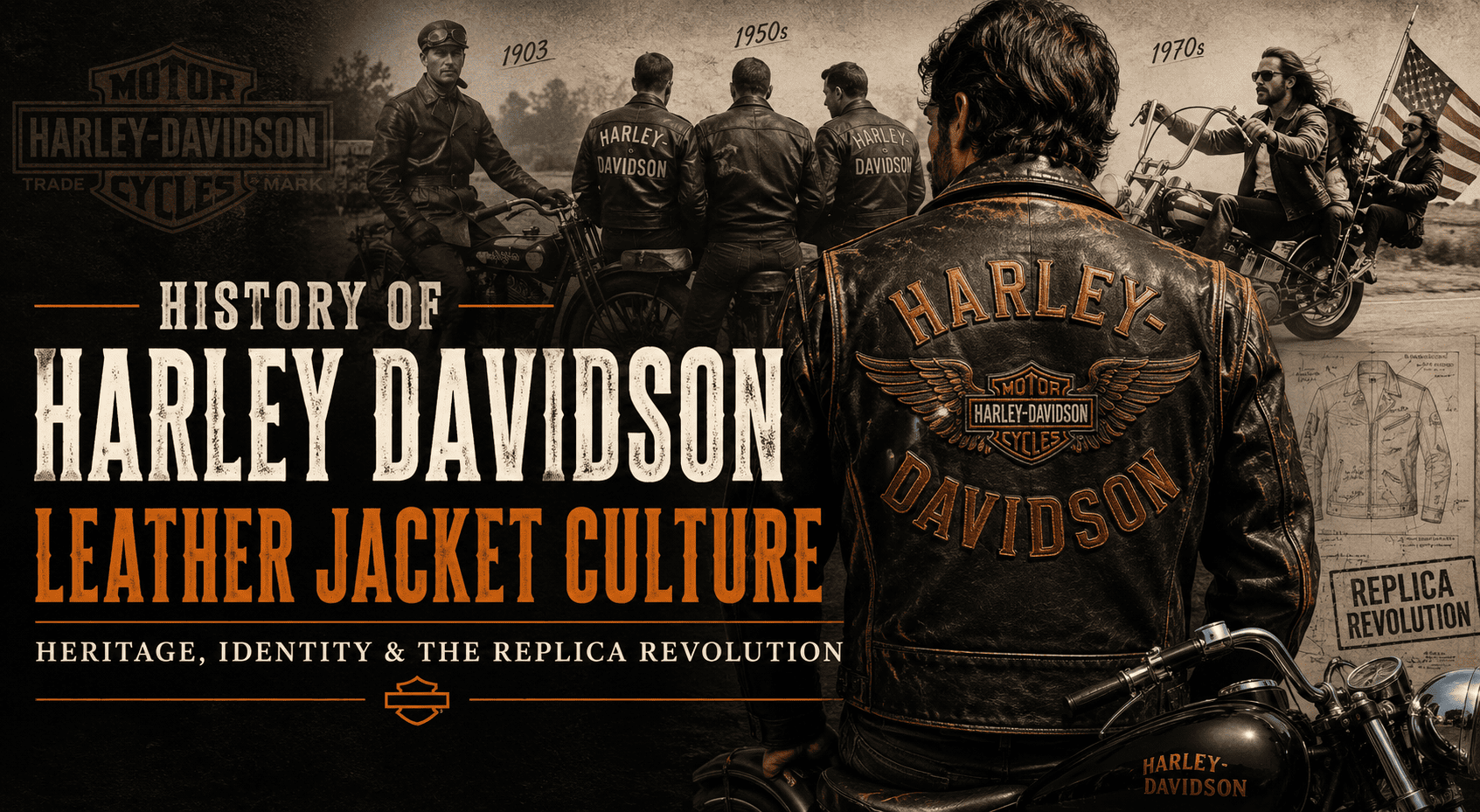
The Harley Davidson leather jacket started as riding equipment. It became a cultural symbol through a sequence of specific historical events — none of them planned by Harley Davidson. This article covers that history, explains what defines a quality jacket at the construction level, and shows how Devilson’s replica range is built on those same specifications.
1. Military Origins (1910s–1940s)
Harley Davidson’s Role in Both World Wars
During World War I, Harley Davidson supplied around 15,000 motorcycles to Allied forces. By 1945 that figure exceeded 90,000 units, used primarily by U.S. Army dispatch and reconnaissance riders.
Riders needed durable, close-fitting outerwear that didn’t restrict saddle movement. The leather jacket issued to military motorcycle riders was an engineered garment — abrasion-resistant, short at the waist, built for function. When the war ended, veterans brought both the machines and the gear home with them.
The Schott NYC Perfecto — Where the Silhouette Was Set
The Perfecto jacket was designed by Irving Schott in 1928, purpose-built for motorcycle riders. Every detail had a reason:
- Asymmetric front zip — positioned off-centre so the pull didn’t press into the rider’s chest at speed.
- Belted waist — reduced wind buffeting and stopped the jacket riding up under riding posture.
- Snap epaulettes — secured straps that could otherwise catch on controls.
- Snap-down lapel — closed flat against the neck to block airflow at the collar.
That silhouette became the template for every HD-style jacket that followed. The functional logic didn’t change — only the materials and production methods evolved.
2. The Post-War Outlaw Era (1945–1960s)

Veterans, Motorcycle Clubs, and the Jacket as Uniform
Post-WWII veterans returning to civilian life found structure in motorcycle clubs. The Boozefighters MC formed in 1946. The first Hells Angels chapter opened in Fontana, California in 1948. These groups wore leather jackets — the same gear they’d used in service — as a collective uniform.
The AMA publicly distanced organised motorcycling from these clubs, reportedly describing 99% of riders as law-abiding citizens. Outlaw clubs adopted the 1%er label in direct response and kept it.
Hollister 1947 — The Incident That Fixed the Image
The AMA-sanctioned rally at Hollister, California on 4th July 1947 drew around 4,000 riders. Minor disruptions followed. Life magazine published a photograph of a rider posing on a motorcycle surrounded by beer bottles — reportedly staged — and the image reached a national audience.
The leather-jacketed motorcyclist became the visual shorthand for social threat. Rider subculture absorbed the image and owned it. The jacket carried that charge from that point forward.
Marlon Brando, The Wild One (1953)
Brando’s costume in the 1953 film — Perfecto-silhouette leather jacket, jeans, peaked cap — is the single most replicated image in motorcycle apparel history. The jacket itself was a civilian rider’s garment, not an HD product. The club in the film rides Triumphs.
None of that mattered commercially. The film’s visual association with Harley Davidson culture in the public mind was immediate and permanent. ‘Harley Davidson jacket’ as a phrase evokes that image to this day.
3. Harley Davidson Builds Its Own Apparel Identity (1960s–1990s)

H-D MotorClothes — From Riders’ Choice to Official Brand
Through the 1950s and 1960s, the ‘Harley look’ was built on third-party jackets riders chose to wear — not on official HD merchandise. Harley Davidson formalised its apparel offer through the H-D MotorClothes division following the 1981 management buyback, using branded leather as a licensing revenue stream alongside motorcycle sales.
Official HD leather jackets carried the Bar & Shield logo designed by Willie G. Davidson and commanded significant retail premiums. The branding became a status marker within rider communities — patch placement on a jacket communicated club affiliation, chapter rank, and riding history to anyone with the relevant cultural knowledge.
What MotorClothes Established as the Construction Standard
MotorClothes production set the benchmark that replica manufacturers still reference: full-grain cowhide outer shells, quilted thermal linings, solid hardware, reinforced pocket zips, and consistent application of the Perfecto silhouette. The design language across variants is stable — asymmetric zip, belted waist, snap collar, external chest pockets with secure closures.
4. Mainstream Adoption — Music, Film, and High Street (1970s–1990s)
The Ramones and The Clash wore unadorned black leather jackets in the mid-1970s as deliberate anti-fashion. Heavy metal culture adopted a studded, heavier version. Both borrowed the jacket’s biker origin as the implicit cultural reference.
By the 1980s, the jacket appeared on screen repeatedly — The Terminator (1984) used it as a single-costume signal of physical threat. By the 1990s it was in mainstream fashion retail.
The jacket reached that position without losing either its rider utility or its subcultural associations. That is unusual for any garment and explains its continued commercial relevance across buyer categories that have no connection to motorcycling.
5. The Anatomy of an Authentic Harley Davidson Style Jacket
Silhouette Details That Separate Functional from Decorative
The asymmetric zip runs lower-left to upper-right across the chest. That placement is the original Schott engineering decision, carried forward unchanged. Jackets that centre the zip are departing from the reference.
The belted waist should function — a belt that passes through real loops and cinches to the body. A decorative belt stitched flat to the jacket achieves nothing riding-related.
The snap-down notched lapel must close flat with no bunching at the collar seam. If it gaps or puckers when fastened, the pattern is wrong.
Leather Grade — The Specification That Determines Everything
Hide type determines long-term performance more than any other single variable:
- Full-grain cowhide — outer surface of the hide, natural grain intact. Densest fibre structure, highest abrasion resistance, develops patina with wear. Minimum specification for riding use.
- Corrected-grain leather — surface sanded, artificial finish applied. Visually uniform but reduced fibre density. Does not develop patina; surface finish eventually flakes.
- Bonded leather — reconstituted fibres with polyurethane coating. Not suitable for riding. Peels within years of regular wear.
Tanning method is secondary but relevant. Chrome tanning gives suppleness and water resistance — the standard for production motorcycle jackets. Vegetable tanning gives denser, stiffer leather that develops superior patina over decades but requires longer break-in.
Hide weight minimum for riding use: 1.0–1.2mm. Below that threshold, the jacket provides no meaningful abrasion protection.
Hardware and Lining — Where Quality Jackets Separate from Budget Ones
YKK zippers are the industry benchmark. The main front zip on a riding jacket should be YKK No. 5 or No. 8 — the heavier grade for the front closure. Pull the zip loaded and check for lateral play in the slider. Budget zippers show it immediately.
Snap fasteners on lapels, epaulettes, and cuffs should be solid brass or zinc alloy. Pot-metal snaps corrode and fail; brass hardware has no practical lifespan limit under normal use.
Interior lining: quilted polyester batting between taffeta and the leather shell provides insulation. A removable liner that detaches via a secondary zip extends the jacket’s seasonal range — relevant in the UK climate where riding temperatures span 35°C across the year.
| Full-grain cowhide maintained correctly does not wear out — it matures. Creasing at the shoulders and elbows, darkening at collar and cuffs, softening across the chest. A jacket that achieves this after years of use is performing exactly as designed. |
6. The Premium Replica Market — Why It Exists and How to Evaluate It
The Pricing Gap That Created the Market
Official HD MotorClothes leather jackets retail above £500. Flagship models exceed £800. That price reflects brand licensing costs and retail margin, not construction quality alone.
The replica market exists for buyers who want the Perfecto silhouette and full-grain construction without paying for the Bar & Shield logo. A replica that reproduces the design language in genuine cowhide without carrying HD trademark is a legitimate product. A jacket with counterfeit HD branding is a trademark infringement. Devilson produces the former.
How to Identify Quality at Point of Purchase
Five checks that separate quality replicas from cheap imitations:
- Weight — a full-grain cowhide jacket at 1.1mm+ feels substantial in hand. Lightweight jackets are thin-hide or corrected-grain.
- Zip pull — quality YKK zippers run smoothly under load, align flush when closed, show no lateral slider movement.
- Snap fasteners — should engage with firm positive resistance and release cleanly. Loose or sticky snaps indicate pot-metal hardware.
- Seam stitching — uniform, no loose thread ends, seam allowances folded and secured on the interior.
- Grain surface — full-grain leather shows natural variation across the hide. Perfectly uniform surface texture is corrected-grain or synthetic.
7. Devilson’s Harley Davidson Replica Jacket Collection
Construction Specification
Every Harley replica jacket in the Devilson core collection is built from full-grain cowhide at a minimum 1.1mm hide weight. Chrome-tanned for suppleness. Natural grain variation is visible — no corrected surface finish.
You can browse styles such as:
- Black Harley Davidson Jackets
- Vintage Harley Jackets
- Cafe Racer Harley Jackets
- Harley Davidson Biker Jackets
- Cowhide Harley Jackets
Hardware: solid zinc alloy and brass throughout. Front zips are YKK specification. Interior linings are quilted with removable panels on riding models for seasonal adjustment.
The asymmetric zip, belted waist, and snap-down lapel on Devilson’s Perfecto-silhouette models are functional implementations — the same engineering rationale as the originals, applied to current production standards.
Sizing for UK Riders
Devilson sizes to UK standard measurements, with fit calibrated to the riding position — not the standing fit used in fashion sizing. A jacket that fits in front of a mirror will pull across the shoulders and ride up at the lower back when you adopt a riding posture. Devilson’s sizing guidance is built around chest measurement plus riding posture allowance to prevent this.
Customisation available on selected models: extended sizing, sleeve length adjustment, and armour pocket integration for CE-rated impact protection inserts. Contact the Devilson team for custom orders.
8. Buying Guide: Choosing the Right Harley Davidson Style Jacket
What to Prioritise — In Order
- Hide specification — full-grain cowhide, 1.0mm minimum. Non-negotiable for riding use.
- Hardware grade — YKK zippers, solid brass or zinc alloy snaps. Indicates the manufacturer’s standard throughout.
- Silhouette accuracy — asymmetric zip, functional belt, sealed collar. All three should be correctly implemented, not simulated.
- Interior construction — lining quality, seam finishing, pocket security. Affects daily usability across the jacket’s lifespan.
- Brand — for buyers prioritising construction quality over logo, the premium replica market gives equivalent specification at lower price.
Vintage Original vs. Modern Premium Replica
Vintage HD MotorClothes jackets from the 1970s–80s appear regularly on eBay and specialist dealers. For collectors with the knowledge to authenticate them, they have historical value.
For riders who intend to wear the jacket: a modern premium replica gives consistent sizing, current construction standards, and no concerns about hide integrity after 40+ years of storage. The evaluation criteria for a collector and a rider are different — be clear which you are before you buy.
9. Leather Jacket Care and Longevity
Conditioning and Waterproofing
Condition full-grain cowhide with a lanolin-based product. Avoid petroleum-based conditioners — they over-soften the hide and degrade stitching thread over time.
Waterproof seasonally with a beeswax or silicone-based protector. Full-grain cowhide has natural water resistance from the intact grain surface, but it diminishes without treatment. Apply before the riding season and again mid-season in UK conditions.
Storage: padded hanger, dry and ventilated space. Never plastic bags — leather needs air circulation. Keep away from direct heat sources; rapid drying shrinks and cracks the hide.
Breaking In a New Jacket
A new full-grain jacket at riding specification will be stiff. That stiffness is the dense fibre structure of quality cowhide — it is not a defect. The jacket will conform to your shoulder width, arm length, and riding posture through use.
Expect 20–30 hours of wear before the jacket reaches its finished fit. Apply a light conditioner before first wear and again after the first month. This accelerates the break-in without forcing it.
Conclusion
The Harley Davidson leather jacket’s cultural position comes from a century of specific events — military supply, post-war rider clubs, Hollister, Brando, punk, Hollywood — that attached meaning to the garment incrementally. The design underneath all of that is a Schott Perfecto from 1928, built to keep a rider functional at speed. That combination of cultural weight and functional integrity is why it remains the reference silhouette for motorcycle leather jackets worldwide.
Devilson’s replica collection is built on the same construction standards as the originals — full-grain cowhide, YKK hardware, accurate silhouette — without the brand premium. If you’re buying a Harley Davidson style jacket to ride in, the specification is what matters.