


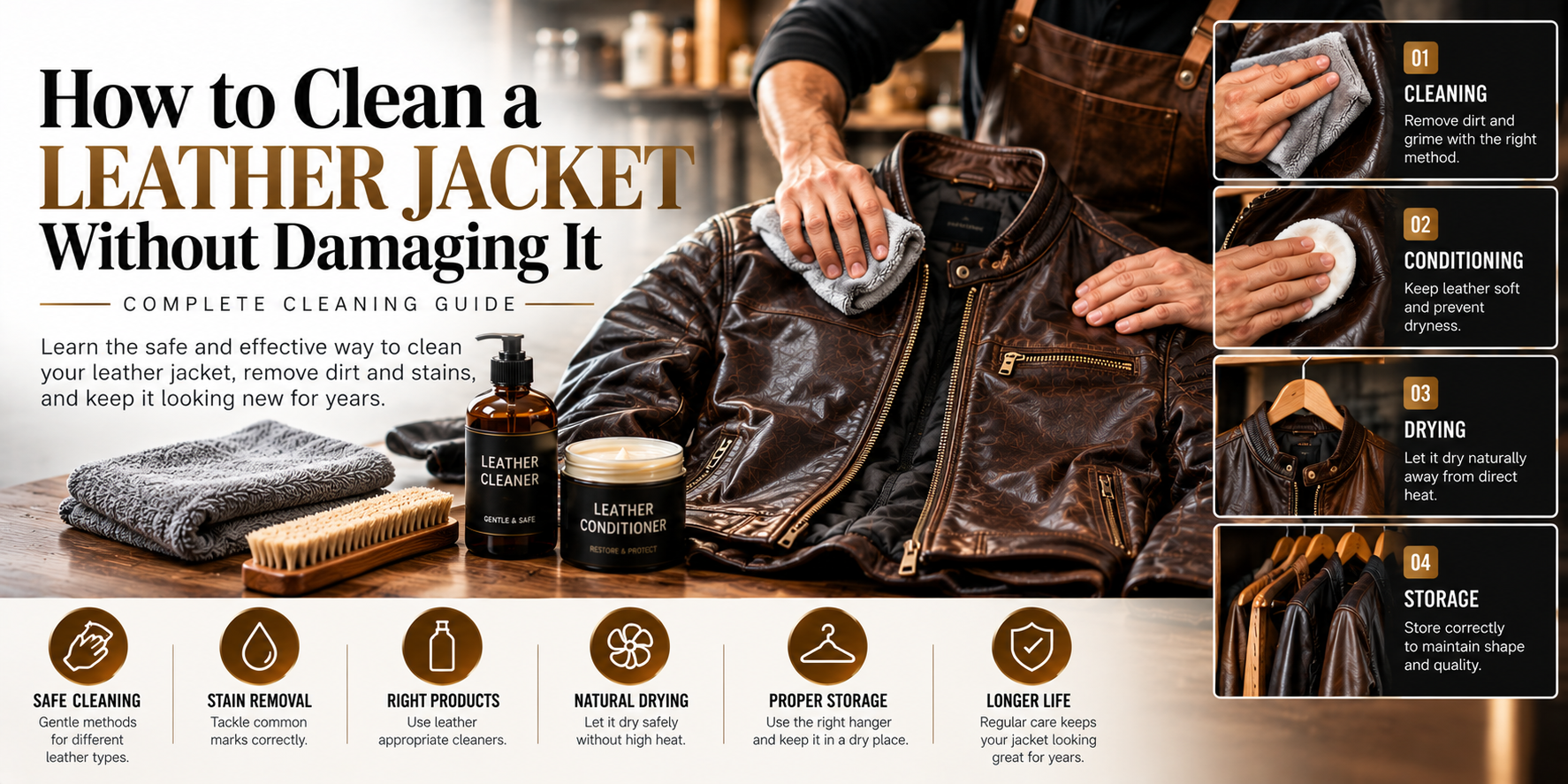
How to Clean a Leather Jacket Without Damaging It
Learn how to remove everyday dirt and stains safely while protecting the leather’s surface, finish and natural character.
Can You Clean a Leather Jacket at Home?
Yes, minor surface dirt and small spots can often be handled with a careful cleaning method. The important part is choosing a method that matches the leather and its finish.
Leather should not automatically be treated like cotton, polyester or other washable fabrics. Water, aggressive chemicals, excessive rubbing and unsuitable cleaning products can alter the appearance or feel of the material.
Before starting, check the manufacturer’s care instructions and identify whether your jacket is smooth finished leather, lambskin, cowhide, suede or another specialized leather.
How to Clean a Leather Jacket Step by Step
Read the Care Instructions
Start with the jacket’s manufacturer instructions. They can identify products and cleaning methods that are suitable for the specific garment.
Remove Surface Dust
Use a soft, clean cloth to gently remove loose dust and surface particles before dealing with spots.
Treat Small Areas First
Concentrate on the affected area rather than unnecessarily cleaning the entire jacket.
Allow Natural Drying
After cleaning, allow the leather to dry naturally away from radiators and intense direct heat.
What Cloth Should You Use to Clean Leather?
A clean, soft cloth is a practical starting point for removing dust and light surface dirt. The goal is to clean the surface without creating unnecessary friction.
Soft Cloth
Use a clean, non-abrasive cloth for gentle surface cleaning and light wiping.
Minimal Moisture
When the care instructions permit damp cleaning, avoid saturating the leather with water.
Clean Section
Use a clean part of the cloth as you work so dirt is not repeatedly transferred back onto the surface.
Always Test a Leather Cleaner First
Patch Testing Helps Reduce Risk
If you are using a leather cleaning product, follow its instructions and test it on a small, inconspicuous area when appropriate.
Check the treated area for unwanted changes before applying the product more broadly. This is especially important when the leather has a distinctive finish, color or texture.
Cleaning Different Types of Leather
Smooth Finished Leather
Follow the manufacturer’s instructions and use products designed for finished leather. Gentle surface cleaning is generally preferable to aggressive scrubbing.
Lambskin
Lambskin can require particularly gentle handling because of its soft feel and delicate surface. Avoid aggressive rubbing and unsuitable cleaning products.
Cowhide
Cowhide can be more substantial, but its exact care still depends on the finish. Follow the jacket’s care guidance rather than assuming all cowhide can be cleaned identically.
Suede
Suede has a different surface structure from smooth leather. Use a care method specifically intended for suede rather than treating it like finished leather.
Nubuck
Nubuck also requires specialized care. Use products and techniques designed specifically for nubuck surfaces.
Specialized Finishes
Vintage, distressed, coated or unusual finishes may react differently to cleaning. Manufacturer guidance should take priority.
How to Remove Small Spots From Leather
Small marks should be approached according to the type of stain and the leather surface. Avoid immediately applying multiple products in an attempt to remove a stubborn mark.
Consider whether the mark is ordinary dirt, water, salt, oil or another substance before choosing a cleaning method.
Begin with the least aggressive method appropriate for the leather instead of immediately using strong chemicals.
Repeated aggressive rubbing can affect the leather surface and may make a mark more noticeable.
Allow the treated area to dry naturally before deciding whether additional care is necessary.
What Should You Avoid When Cleaning Leather?
Gentle Cleaning
- Follow the manufacturer’s care instructions.
- Use a clean, soft cloth.
- Test unfamiliar products first.
- Work on small areas when appropriate.
- Allow natural drying.
Aggressive Cleaning
- Do not scrub leather aggressively.
- Do not soak the jacket unnecessarily.
- Do not use random household cleaners.
- Do not apply intense direct heat.
- Do not use a suede method on smooth finished leather or vice versa.
How Should a Leather Jacket Dry After Cleaning?
After cleaning, give the jacket enough time to dry naturally. Avoid trying to speed up the process with intense heat.
Avoid Radiators and High Heat
Do not place a wet or damp leather jacket directly against a radiator or other concentrated heat source. Allow the garment to dry gradually at room temperature.
When Should You Use Professional Leather Cleaning?
Professional cleaning can be worth considering when a stain is extensive, the leather is particularly delicate, the finish is specialized, or the jacket requires restoration beyond routine surface care.
Consider Professional Help For
Large or persistent stains, extensive contamination, significant discoloration, delicate specialty finishes, or situations where the appropriate cleaning method is uncertain.
Leather Jacket Cleaning Checklist
| Cleaning Stage | Recommended Approach | Avoid |
|---|---|---|
| Preparation | Identify leather type and read care instructions. | Assuming every leather jacket can be cleaned identically. |
| Surface Dirt | Use a soft, clean cloth. | Aggressive rubbing. |
| Cleaning Product | Use a leather-appropriate product and test it first. | Random household cleaners. |
| Stains | Identify the stain and use the least aggressive suitable method. | Repeatedly attacking the stain with multiple products. |
| Drying | Allow natural drying at room temperature. | Radiators and concentrated high heat. |
| Difficult Cases | Consider professional leather cleaning. | Experimenting on delicate or valuable leather. |
Clean Leather Gently and According to Its Finish
The safest leather-cleaning routine starts with identifying the material, following the manufacturer’s instructions, using a gentle method, testing unfamiliar products and allowing the jacket to dry naturally. When the stain or leather is beyond routine care, professional cleaning is the safer route.