


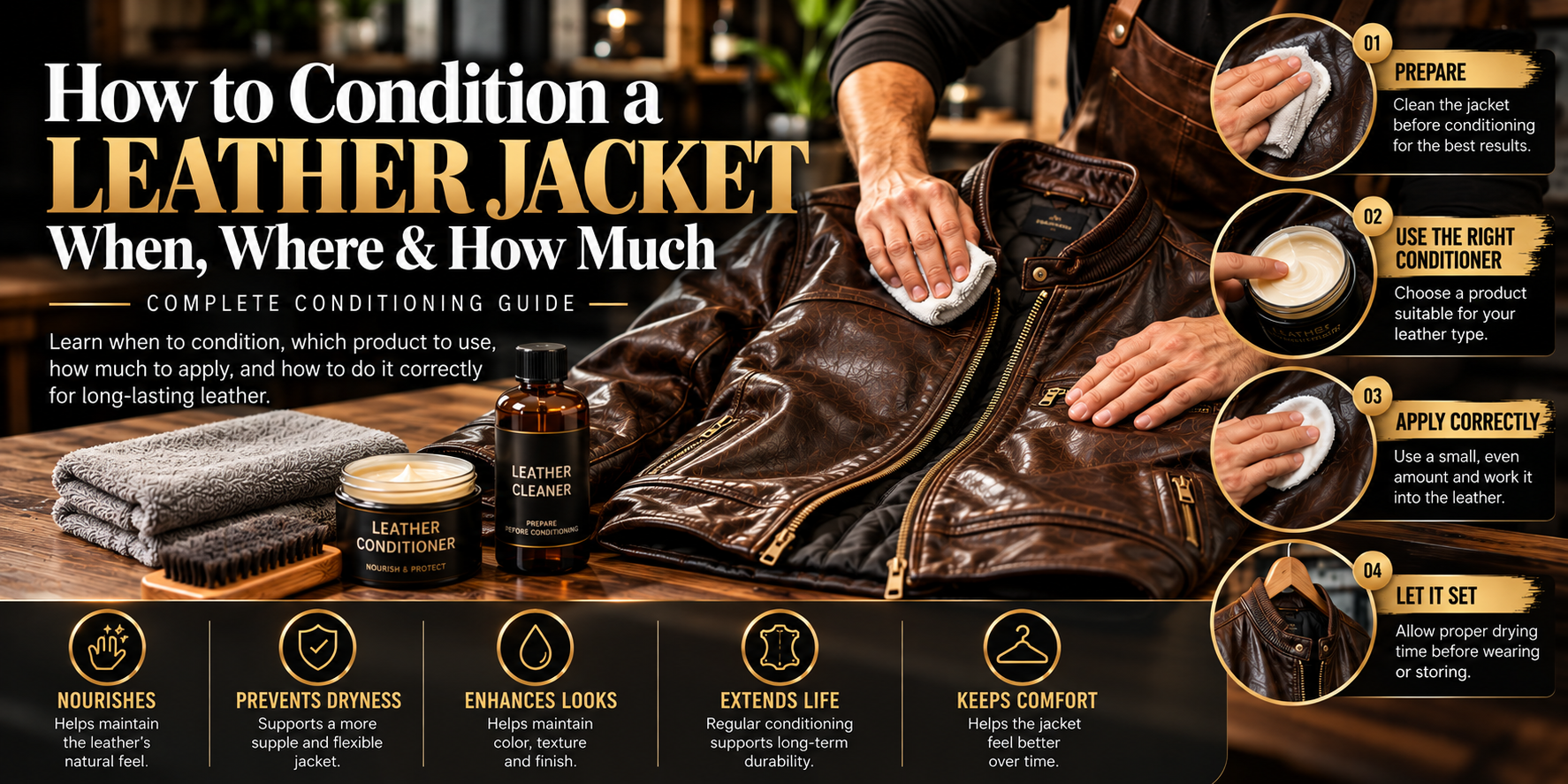
How to Condition a Leather Jacket: When, Where & How Much
Understand when leather conditioning is appropriate, how to prepare the surface, how much product to apply, and why the leather type matters.
What Does Leather Conditioning Do?
Conditioning should be treated as a specific leather-care step rather than something that needs to be done every time the jacket is worn.
The right approach depends on the leather, its finish, the jacket’s existing condition and the care instructions supplied by the manufacturer.
Before applying any conditioner, identify the leather surface and make sure the product is intended for that type of leather.
When Should You Condition a Leather Jacket?
Conditioning is most useful when the leather’s care requirements call for it. Instead of following a rigid calendar, consider the condition of the jacket and the manufacturer’s guidance.
After Appropriate Cleaning
If cleaning has removed surface care products and the leather’s instructions call for conditioning afterward, conditioning can form part of the maintenance process.
When the Leather Needs Care
Pay attention to the leather’s condition rather than automatically applying conditioner at every interval.
According to Leather Type
Different leather types and finishes can have different maintenance requirements, so the same conditioning routine should not be assumed for every jacket.
Follow Manufacturer Guidance
The jacket’s care instructions should take priority when they specify a particular conditioner, method or frequency.
How to Choose a Leather Conditioner
The conditioner should be appropriate for the leather and its finish. Avoid selecting a product simply because it is labeled as a general leather product.
Match the Product to the Leather
Check the product instructions and the jacket’s care guidance before application. Specialty surfaces may require a different product or may not be suitable for a conventional conditioner.
Why Patch Testing Matters
A conditioner can affect the appearance or feel of leather. Testing first gives you an opportunity to check how the product behaves on your particular jacket.
Select a small area that is not immediately visible when the jacket is worn.
Use only enough product to test the leather rather than treating a large section immediately.
Check whether the leather’s appearance, color or surface changes in an unwanted way.
If the product is not appropriate for the leather or produces an unwanted result, do not continue applying it.
How Much Leather Conditioner Should You Use?
More conditioner is not automatically better. The amount should be controlled and appropriate for the surface being treated.
Start Small
Begin with a small amount rather than applying a heavy layer across the jacket.
Spread Evenly
Work the product evenly according to its instructions rather than leaving concentrated areas of conditioner.
Avoid Saturation
Excessive product can create an unnecessarily heavy surface treatment. Follow the product instructions instead.
How to Apply Leather Conditioner
Start With a Clean, Suitable Surface
Conditioning should not be used as a substitute for cleaning. Prepare the jacket according to its care instructions first.
Test the Conditioner
Perform a patch test in an inconspicuous location before treating visible areas.
Apply a Controlled Amount
Use a small amount and distribute it according to the conditioner manufacturer’s instructions.
Work Methodically
Move across the jacket in manageable sections so the conditioner is distributed consistently.
Allow the Jacket to Set
Follow the product instructions for drying or setting time before wearing or storing the jacket.
Conditioning by Leather Type
Leather type is an important part of the conditioning decision. The appropriate product and frequency can vary depending on the material and finish.
Cowhide
Follow the jacket’s care instructions and choose a conditioner intended for its particular finish.
Lambskin
Soft leather can require particularly careful handling. Avoid assuming that a heavy conditioning treatment is appropriate.
Finished Leather
The finish affects how products interact with the surface. Follow the manufacturer’s care guidance.
How Often Should You Condition a Leather Jacket?
There is no single conditioning schedule that applies to every leather jacket. Frequency should be determined by the leather, finish, use and care instructions.
Leather Conditioning: Do’s and Don’ts
Better Conditioning Practice
- Read the jacket’s care instructions.
- Choose a product appropriate for the leather.
- Patch test before broader application.
- Start with a small amount.
- Follow the product’s application instructions.
- Allow appropriate drying or setting time.
Avoid These Mistakes
- Do not assume every leather needs the same conditioner.
- Do not skip the patch test with an unfamiliar product.
- Do not apply an excessive amount.
- Do not treat conditioning as a substitute for cleaning.
- Do not ignore the leather’s finish.
- Do not use a product against the manufacturer’s guidance.
How Long Should Conditioner Dry?
Drying or setting time depends on the conditioner being used. Rather than relying on a universal time, follow the instructions supplied with the specific product.
Before You Condition Your Jacket
Know whether you are dealing with cowhide, lambskin or another finished leather surface.
Manufacturer guidance should be your first reference.
Use a conditioner intended for the leather and finish.
Test the product in an inconspicuous area before broader application.
Start small and distribute the conditioner according to its instructions.
Follow the conditioner instructions before wearing or storing the jacket.
Important: More Conditioner Is Not Always Better
Conditioning should be controlled and appropriate for the leather. Applying more product does not automatically provide better care. The leather type, finish, product instructions and condition of the jacket should all be considered.
Condition With Purpose, Not Just Habit
The right conditioning routine starts with knowing your leather. Choose an appropriate product, patch test it, apply a controlled amount, follow the product’s instructions and allow sufficient setting time. Most importantly, use the manufacturer’s care guidance as the starting point for your jacket.