


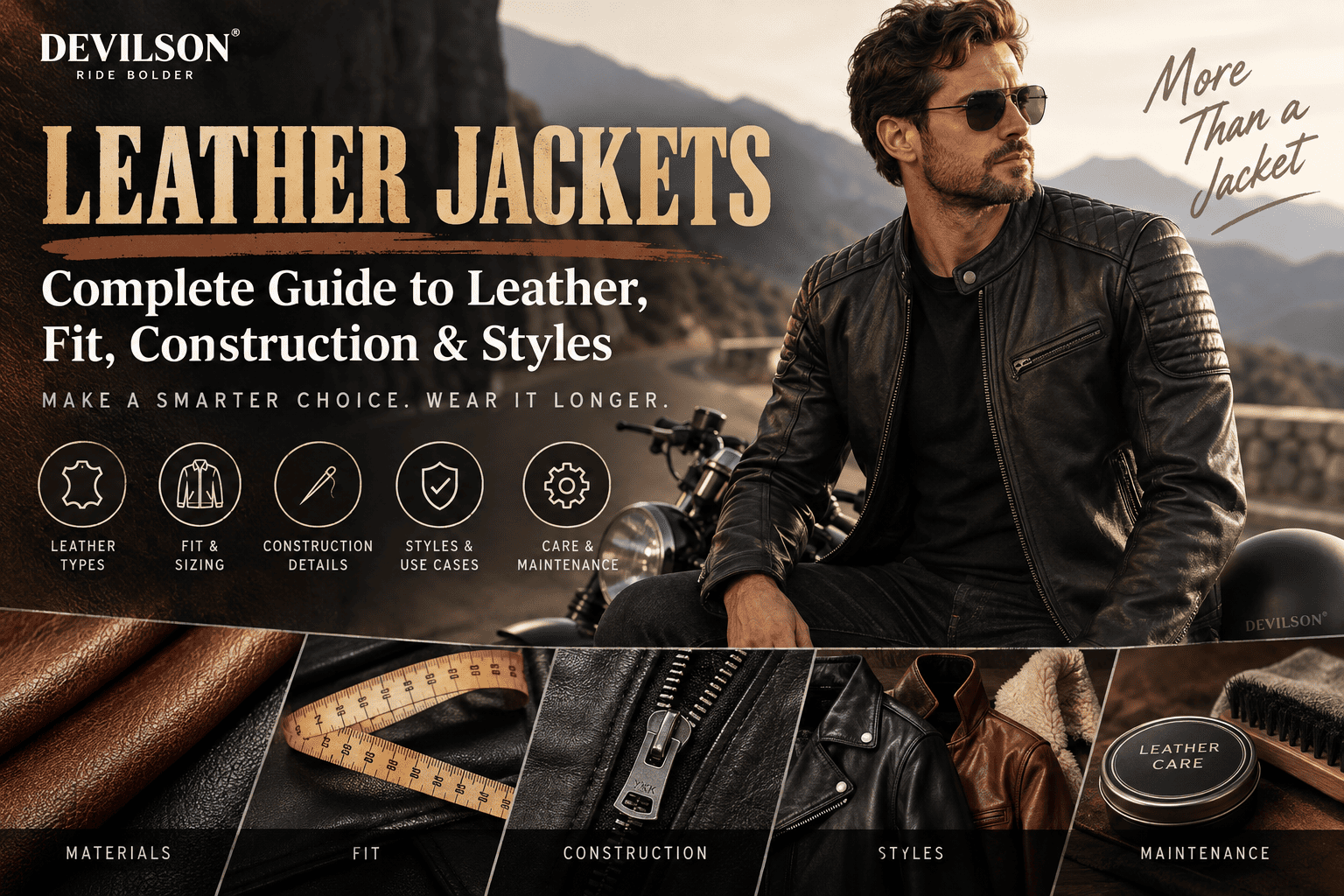
A good leather jacket is more than a piece of outerwear. Leather type, hide quality, thickness, construction, fit and intended use all affect how a jacket looks, feels and performs over time.
What Should You Look for in a Leather Jacket?
When comparing leather jackets, focus on six key areas rather than judging a jacket only by its appearance or price.
01. Leather
Understand the hide type, grade, finish and approximate thickness.
02. Fit
Check chest, shoulders, sleeves, waist and room for layers.
03. Construction
Look at stitching, seams, lining, closures and stress points.
04. Hardware
Examine zippers, snaps, buckles and other frequently used components.
05. Purpose
Decide whether you need fashion outerwear, casual wear or motorcycle gear.
06. Maintenance
Choose a leather finish that matches the care you are prepared to provide.
Understanding Leather Types
Leather is not a single material. Different animal hides and finishing processes create very different levels of softness, structure, weight and durability.
Cowhide is a strong, structured choice for motorcycle and biker jackets. Heavier jacket-grade cowhide can offer greater abrasion resistance than lightweight fashion leathers, although the trade-off is additional weight and stiffness.
Common uses:
- Motorcycle jackets
- Biker jackets
- Riding jackets
- Structured leather outerwear
Lambskin is lighter and softer than typical heavy cowhide. That makes it popular for fashion jackets, slim silhouettes, bombers and everyday outerwear where flexibility and a softer drape are important.
Common uses:
- Fashion jackets
- Slim-fit leather jackets
- Lightweight bombers
- Everyday casual wear
Shearling is sheepskin with the wool retained. It is primarily chosen for warmth and insulation rather than lightweight construction. Shearling jackets can be substantially warmer and heavier than standard leather outerwear.
Suede is made from the softer, napped side of an animal hide. It has a distinctive texture and is commonly used for fashion-focused jackets, western styles, truckers and casual outerwear.
Because the surface can be more delicate than smooth leather, suede requires care appropriate to its specific finish.
Full-Grain, Top-Grain and Other Leather Terms
Leather terminology can be confusing. Understanding the basic differences helps you evaluate product descriptions more intelligently.
Full-Grain Leather
Full-grain leather retains the natural outer surface of the hide. Natural variations, markings and grain characteristics can remain visible.
Top-Grain Leather
Top-grain leather comes from the upper portion of the hide but may be corrected or processed to create a more consistent appearance.
Corrected Leather
More extensive surface processing can create a particular texture, color or appearance. The important point is whether the material suits the intended jacket.
If you want a deeper explanation of leather grades, hide types and material characteristics, see our Leather Quality & Materials guide .
Does Leather Thickness Matter?
A heavy cowhide motorcycle jacket and a lightweight lambskin bomber have completely different design objectives. Comparing them only by thickness misses the reason each jacket was made.
For motorcycle use, evaluate the complete protective construction rather than relying on leather thickness alone.
Leather Jacket Fit: How Should It Fit?
A leather jacket should feel close to the body without restricting normal movement. The correct fit depends on the jacket style and what you intend to wear underneath it.
Fashion Leather Jackets
Fashion jackets can generally follow the body’s shape more closely.
- Check shoulder placement.
- Make sure the chest does not pull when zipped.
- Check sleeve length.
- Make sure normal arm movement is comfortable.
Motorcycle Leather Jackets
Motorcycle jackets need to be evaluated for riding posture and protective equipment.
- Check shoulder width.
- Allow room for compatible armor.
- Check sleeve length while riding.
- Consider back length and waist adjustment.
A jacket that feels perfect while standing can feel different once you lean forward on a motorcycle. If you regularly wear protective armor underneath, allow enough room for it without making the jacket excessively loose.
Leather Jacket Sizing: What Measurements Matter?
Do not choose a leather jacket based only on S, M, L, XL or another familiar clothing size. Sizing varies between manufacturers and patterns.
| Measurement | Why It Matters |
|---|---|
| Chest | Determines overall torso comfort. |
| Shoulders | Helps prevent restricted arm movement. |
| Sleeve Length | Important for coverage and appearance. |
| Waist | Particularly important for fitted jackets. |
| Jacket Length | Affects proportions and coverage. |
| Back Length | Especially important for motorcycle use and layering. |
Always compare your measurements with the manufacturer’s garment-specific size chart before ordering.
Leather Jacket Construction: What Should You Check?
Leather quality matters, but construction matters just as much. Look closely at the areas that receive the most stress during everyday wear.
Stitching
Check shoulder seams, armholes, sleeves, pocket openings and other high-stress areas for consistent and secure stitching.
Zippers
Look for smooth operation, secure attachment, strong teeth and proper alignment.
Lining
The lining affects comfort, movement and how easily the jacket can be put on and removed.
Common Leather Jacket Styles
| Style | Best Suited For | Typical Characteristics |
|---|---|---|
| Biker | Motorcycle lifestyle and riding | Asymmetric zip, structured shape and substantial hardware. |
| Motorcycle | Riding | Functional details, riding-oriented fit and protective construction. |
| Bomber | Casual everyday wear | Shorter body and simple, versatile silhouette. |
| Racer | Minimal motorcycle-inspired style | Stand collar, clean front and streamlined profile. |
| Aviator | Cold weather and heritage styling | Larger collar and substantial construction. |
| Varsity | Casual streetwear | Sport-inspired panels and snap or zip closure. |
| Suede | Fashion and casual wear | Soft napped texture and distinctive visual character. |
| Shearling | Cold climates | Leather exterior with natural wool insulation. |
Motorcycle Leather Jackets vs Fashion Leather Jackets
If motorcycle protection is your priority, look for a jacket specifically designed and tested as motorcycle protective apparel. Do not assume that every thick leather fashion jacket provides equivalent protection.
For everyday fashion, a lighter lambskin or suede jacket may be more comfortable and practical.
If riding is your primary use, explore Devilson’s Leather Motorcycle Jackets .
What Leather Should You Choose?
Use your intended purpose as the starting point.
Choose Cowhide If:
- You want a structured jacket.
- Durability is a major priority.
- You are buying a motorcycle or biker jacket.
- You prefer a heavier leather feel.
- You want leather that develops character with wear.
Choose Lambskin If:
- Softness is important.
- You want a lightweight jacket.
- You prefer a closer fashion fit.
- You want easy movement.
- You mainly wear the jacket casually.
Choose Shearling If:
- Warmth is the priority.
- You live in a cold climate.
- You want substantial winter outerwear.
- You like traditional aviator styling.
Choose Suede If:
- Texture is important.
- You want a softer visual appearance.
- You mainly want casual or fashion wear.
- You are prepared to provide appropriate care.
How to Tell if a Leather Jacket Is Worth Buying
Before ordering, use this simple checklist:
- What type of leather is used?
- What leather grade is specified?
- What is the approximate leather thickness?
- Is the jacket designed for fashion or motorcycle use?
- Are garment measurements provided?
- What type of lining is used?
- How are the major stress points constructed?
- What hardware is used?
- How should the leather be maintained?
- Is custom sizing available?
Leather Jacket Care
1. Remove Surface Dirt
Use a soft cloth to remove ordinary dust and dirt. Avoid aggressive scrubbing.
2. Avoid Direct Heat
If the jacket becomes wet, allow it to dry naturally. Avoid radiators, heaters and intense direct heat.
3. Condition Appropriately
Use a conditioner suitable for the specific leather and finish. Suede requires different treatment from smooth leather.
4. Use a Proper Hanger
A broad-shouldered hanger helps preserve the jacket’s shape during storage.
5. Follow Care Instructions
Leather finishes differ, so follow the manufacturer’s recommendations whenever available.
6. Avoid Long-Term Compression
Store the jacket where it has enough space to retain its natural shape.
Choosing a Leather Jacket From Devilson
Devilson offers different leather jacket categories for different use cases, rather than treating every jacket as the same type of outerwear.
For motorcycle-focused buyers, the Leather Motorcycle Jackets collection is the appropriate starting point when riding use, structured leather and motorcycle-specific features are priorities.
For traditional motorcycle-inspired styling, the Leather Biker Jackets collection is a natural choice.
For cold-weather and heritage styling, explore Men’s Aviator Leather Jackets .
For sport-inspired casual styling, the Varsity Leather Jackets collection is another option.
Find the Right Leather Jacket for Your Use
Compare leather type, construction, fit and intended use before choosing your jacket. Start with the Devilson category that matches how you plan to wear it.
Frequently Asked Questions
Is cowhide better than lambskin for a leather jacket?
Are leather motorcycle jackets safer than textile jackets?
Should a leather jacket fit tight?
Does leather stretch over time?
Can you wear a leather jacket in the rain?
How often should a leather jacket be conditioned?
What is the best leather for a motorcycle jacket?
How do I know what leather jacket size to buy?
Final Takeaway
Choosing a leather jacket becomes much easier when you stop comparing jackets only by appearance or price.
Start with the intended use. Then evaluate the leather, thickness, construction, fit, hardware, lining and care requirements.
For riding, prioritize motorcycle-specific construction and protective features. For everyday fashion, prioritize comfort, weight, silhouette and the character of the leather.
A well-chosen leather jacket should suit the way you actually live—not simply look good in a product photograph.