


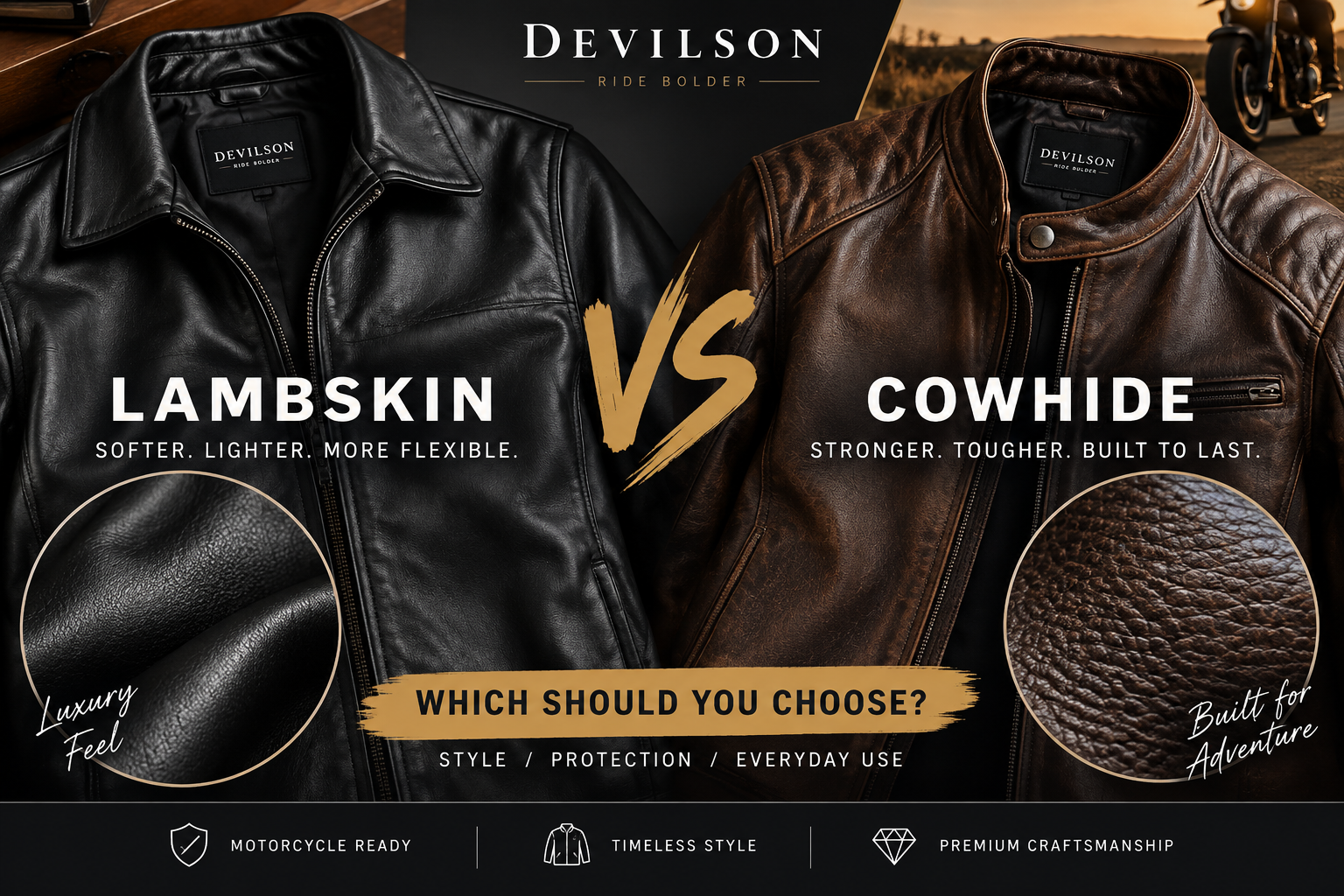
Lambskin vs Cowhide Leather Jackets: Which Should You Choose?
The right leather depends on how you plan to wear the jacket. Lambskin is softer, lighter and more flexible, while cowhide is generally heavier, more structured and more abrasion-resistant.
Choose lambskin if softness, lightweight comfort and a refined fashion silhouette are your priorities. Choose cowhide if you want more structure, substantial leather and greater abrasion resistance, particularly for rugged or motorcycle-oriented use.
Lambskin vs Cowhide at a Glance
The biggest differences are softness, weight, structure, flexibility and abrasion resistance.
| Feature | Lambskin | Cowhide |
|---|---|---|
| Feel | Very soft and supple | Firmer and more structured |
| Weight | Generally lighter | Generally heavier |
| Flexibility | High | Moderate when new |
| Break-in | Usually minimal | Usually takes longer |
| Drape | Natural and fluid | More structured |
| Abrasion Resistance | Generally lower at typical fashion weights | Generally higher |
| Best Suited To | Fashion and everyday wear | Motorcycle, biker and rugged jackets |
Understanding the Two Materials
Lambskin Leather
Lambskin is valued for its exceptionally soft hand feel, flexibility and lightweight character. It tends to follow the body’s shape and works particularly well for fitted fashion jackets.
- Soft and supple feel
- Lightweight construction
- Excellent flexibility
- Natural drape
- Minimal break-in
Cowhide Leather
Cowhide generally provides a firmer, more substantial leather feel. It is commonly selected when structure, ruggedness and abrasion resistance are more important.
- Substantial leather feel
- Greater structure
- Generally higher abrasion resistance
- Suitable for rugged outerwear
- Common in motorcycle jackets
Which Leather Is Softer?
Lambskin is generally softer than cowhide. It has a supple character that allows the jacket to drape naturally around the body.
Cowhide is normally firmer, especially when new. However, firmness should not be confused with poor quality. Leather grade, thickness, tanning and finishing can all influence how a jacket feels.
Softness does not automatically mean higher leather quality. It means the material has different physical characteristics that may be better suited to certain applications.
Which Is More Durable?
Cowhide is generally the more durable choice when durability means resistance to abrasion, wear and maintaining a structured outer layer.
This is one reason cowhide is commonly selected for motorcycle and biker jackets.
However, leather durability depends on more than the animal source. Leather quality, thickness, tanning, stitching, lining, hardware, care and frequency of use all affect how long a jacket lasts.
Which Is Better for Motorcycle Jackets?
Cowhide is generally the more appropriate starting material for a motorcycle jacket. Its structure and abrasion resistance make it commonly used for riding-focused leather jackets.
However, leather type alone does not determine whether a jacket provides adequate motorcycle protection.
Look Beyond the Leather
- Leather thickness
- Seam construction
- Reinforced areas
- Armor compatibility
- Fit and body coverage
- Closures and hardware
Important Safety Point
A fashion leather jacket should not automatically be treated as protective motorcycle equipment.
For riding, evaluate the complete protective construction and relevant certified protective equipment.
Which Is Better for Fashion Jackets?
Lambskin is often a strong choice for fashion jackets where softness, light weight and a close-fitting silhouette matter.
It works particularly well for slim jackets, lightweight bombers and everyday city wear.
Cowhide can also work extremely well for fashion. Its more substantial structure is useful when the design calls for a rugged silhouette or heavier outer layer.
Does Cowhide Need a Break-In Period?
Usually, yes. New cowhide can feel firm because it has more structure. Regular wear gradually allows the leather to become more flexible and conform to the wearer.
Lambskin normally requires much less break-in because it begins with a softer and more supple character.
Is Lambskin Lower Quality Than Cowhide?
No. Lambskin and cowhide are different leather types with different physical characteristics. One should not automatically be considered higher quality than the other.
A better way to evaluate a leather jacket is to consider the hide type, leather grade, thickness, tanning, finishing, stitching, hardware, lining, fit and intended use.
Full-Grain Cowhide vs Full-Grain Lambskin
“Full-grain” and “lambskin” describe different aspects of leather.
Lambskin identifies the animal source.
Cowhide also identifies the animal source.
Full-grain describes the condition and treatment of the outer grain surface.
Therefore, you can have full-grain lambskin and full-grain cowhide. Leather grade should not be confused with animal source.
Does Leather Thickness Matter?
Yes, but thickness should not be considered by itself.
Thicker leather generally contributes more structure and weight, while thinner leather can provide greater flexibility and a lighter feel.
A lightweight lambskin fashion jacket may intentionally use thinner leather for drape and comfort, while a motorcycle jacket may use substantially heavier leather where structure and abrasion resistance are important.
How to Choose Between Lambskin and Cowhide
Start with the way you will actually use the jacket rather than choosing based solely on the name of the leather.
Choose Lambskin If…
- You prioritize softness
- You want a lightweight jacket
- You prefer flexible leather
- You want a fitted silhouette
- You mainly wear the jacket casually
- Fashion is the primary purpose
Choose Cowhide If…
- You prefer structured leather
- You want a substantial jacket
- Abrasion resistance matters
- You like rugged styling
- You expect heavy everyday use
- You want motorcycle-oriented construction
What Should You Check Before Buying?
Leather type is only one part of a good leather-jacket buying decision.
Lambskin or Cowhide: Which Does Devilson Use?
Devilson uses both lambskin and cowhide because the two materials serve different design purposes.
Lambskin is particularly suited to fashion-focused designs where softness, flexibility and a lighter feel are important. Cowhide is commonly associated with motorcycle, biker and rugged jacket designs where greater structure and abrasion resistance are priorities.
The best approach is to compare the material and construction specifications of each jacket against the way you plan to wear it.
Choose the leather that fits the way you wear it.
Explore Devilson’s leather jackets by intended use, material and construction. For motorcycle-focused designs, look for purpose-built riding construction rather than choosing based on leather type alone.
Frequently Asked Questions
Is lambskin better than cowhide for everyday wear?
Lambskin is often more comfortable for everyday fashion wear because it is soft, lightweight and flexible. Cowhide may be preferable when you want a more structured and rugged jacket.
Is cowhide better for motorcycle riding?
Cowhide is generally more appropriate for riding-focused jackets because it offers greater structure and abrasion resistance than typical lightweight lambskin fashion leather. The complete protective construction still needs to be evaluated.
Does lambskin leather last?
Yes. A well-made lambskin jacket can provide years of service when properly cared for and used as intended. It is generally better suited to fashion and everyday outerwear than high-abrasion applications.
Does cowhide leather soften?
Yes. Cowhide generally becomes more flexible through regular wear and gradually conforms to the wearer.
Can lambskin be used for a biker jacket?
Yes. Lambskin can be used for biker-style fashion jackets. However, a lightweight fashion jacket should not automatically be considered protective motorcycle equipment.
Which leather is lighter?
Lambskin is generally lighter, particularly when compared with typical motorcycle-grade cowhide.
Is lambskin lower quality than cowhide?
No. They are different leather types with different characteristics. Leather grade, thickness, tanning, finishing and construction are all important when judging a jacket.
Should I choose lambskin or cowhide?
Choose lambskin when softness, flexibility and lightweight comfort are your priorities. Choose cowhide when structure, abrasion resistance and rugged or motorcycle-oriented use are more important.
The Bottom Line
There is no universal winner between lambskin and cowhide. Lambskin is particularly suited to soft, lightweight fashion jackets, while cowhide is generally better suited to structured, rugged and motorcycle-oriented designs.
Match the leather to the purpose of the jacket, then evaluate grade, thickness, construction, fit and care requirements before buying.