


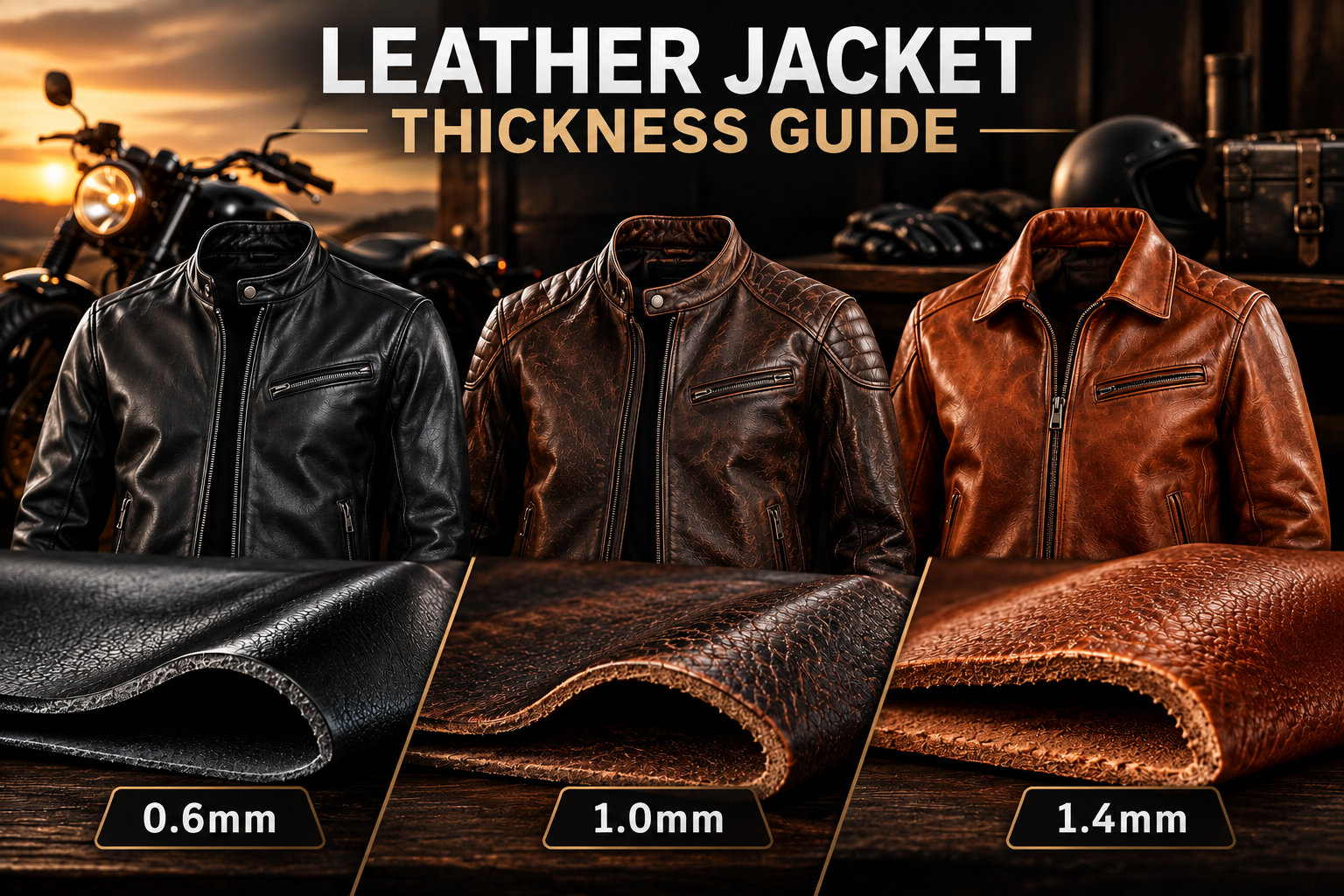
Leather Jacket Thickness Guide
What do 0.6mm, 1.0mm and 1.4mm mean? Understand leather thickness, compare your options, and choose the right jacket for your intended use.
Leather Jacket Thickness: The Quick Answer
When shopping for a leather jacket, you may see specifications such as 0.6mm, 1.0mm, 1.2mm or 1.4mm. These numbers describe the approximate thickness of the leather, measured in millimeters.
Leather type, construction, stitching, fit, protective equipment and intended use all matter when evaluating a leather jacket.
What Does Leather Thickness Mean?
Leather thickness is the physical depth of the leather hide or skin, normally measured in millimeters (mm).
Leather can also be split or shaved during processing to achieve a desired thickness. The actual feel of a leather jacket depends on the leather species, tanning, finishing, construction and garment design — not just the number in the specification.
| Leather Thickness | General Feel | Typical Advantage | Suitable For |
|---|---|---|---|
| 0.6mm | Very light and flexible | Comfort and mobility | Lightweight fashion jackets |
| 1.0mm | Moderate | Balance of flexibility and substance | Everyday leather jackets |
| 1.2mm | Substantial | Structure and durability | Heavier everyday/riding jackets |
| 1.4mm | Heavy and robust | Greater material thickness and structure | Motorcycle and heavy-duty applications |
| 1.6mm+ | Very substantial | Heavy-duty construction | Specialized applications |
Is Thicker Leather Always Better?
No. Thicker leather is not automatically better. It is simply more suitable for some applications than others.
A 1.4mm leather jacket may feel more substantial than a 0.6mm fashion jacket, but that does not make it the better choice for every customer.
- Consider how you intend to use the jacket.
- Consider the weight and flexibility you prefer.
- Check the type and quality of leather.
- Evaluate the overall construction.
- For riding, consider the complete protective system.
0.6mm Leather: Lightweight and Flexible
At approximately 0.6mm, leather can provide a noticeably lightweight feel.
This thickness can be attractive for customers who prioritize low garment weight, softness, flexibility and everyday comfort.
It can work particularly well for fashion-focused jackets where maximum mobility and a lightweight construction are more important than a heavy, structured feel.
1.0mm Leather: A Practical Middle Ground
Around 1.0mm, leather offers a useful balance between flexibility and structure.
A jacket in this range may feel more substantial than a very lightweight 0.6mm garment while remaining comfortable for regular wear.
- Everyday wear
- Casual motorcycle use
- Cooler weather
- Customers wanting a more structured silhouette
1.4mm Leather: Heavy and Substantial
A 1.4mm leather jacket contains considerably more material thickness than a lightweight 0.6mm jacket.
The result is generally a heavier, more structured garment with a substantial feel.
Important Motorcycle Protection Note
Leather thickness should not be treated as a guarantee of motorcycle protection. A protective motorcycle garment should be evaluated as a complete system, including material performance, seams, fit, coverage, protectors and applicable testing.
Leather Thickness vs. Leather Quality
Thickness and quality are two different things.
A thicker piece of leather can still be unsuitable for a particular application if the leather, construction, stitching or garment design does not meet the required requirements.
1. Leather Type
Different animal hides have different natural characteristics. Cowhide is commonly associated with heavier and more structured clothing, while lambskin is frequently used for lightweight fashion garments.
2. Leather Construction
Full-grain, corrected-grain, split, suede and other leather constructions can have different characteristics. Thickness should therefore be considered alongside the type and processing of the leather.
3. Stitching
For a motorcycle jacket, seams are an important part of overall construction. Strong leather does not make a garment protective if critical seams or connection points are poorly constructed.
4. Fit
A jacket should allow the wearer to move naturally without excessive looseness that could affect the positioning of protective components.
5. Protective Equipment
Motorcycle protection involves more than the outer material. Shoulder, elbow, back and other protectors can form part of a protective clothing system.
Leather Thickness for Fashion vs. Motorcycle Jackets
Fashion Leather Jacket
- Soft hand feel
- Lightweight construction
- Flexible movement
- Focus on appearance
- Everyday comfort
Motorcycle Leather Jacket
- Abrasion-focused construction
- Reinforced impact areas
- Protective armor
- Secure fit and coverage
- Riding-oriented construction
How to Choose the Right Leather Jacket Thickness
Use the following process rather than simply choosing the thickest leather available.
Identify the Main Purpose
Decide whether you need the jacket primarily for fashion, everyday wear, commuting, touring, sport riding or another specific use.
Consider Garment Weight
If you prefer lightweight clothing, very thick leather may feel unnecessarily heavy.
Check the Leather Type
Do not compare thickness without considering whether you are comparing cowhide, lambskin, goatskin or another leather.
Check Construction
Examine stitching, seams, reinforcement, zippers, lining, cuffs, closures and other construction details.
For Riding, Check Protection
Investigate protective construction and applicable certification rather than relying exclusively on the leather thickness number.
Choosing a Devilson Leather Jacket
When comparing leather jackets from Devilson, use leather thickness as one part of the buying decision, not the only specification.
For fashion-focused jackets, consider the combination of leather type, hand feel, fit, weight and design.
For motorcycle use, prioritize a garment designed for riding and examine its material, construction, fit, protective components and relevant testing or certification.
Frequently Asked Questions
Is 0.6mm leather too thin for a jacket?
Not necessarily. A 0.6mm leather jacket can be suitable for lightweight fashion and everyday use where flexibility and low weight are important.
Is 1.0mm leather good for a leather jacket?
Yes. Around 1.0mm can provide a practical balance between flexibility and structure. Suitability still depends on leather type, construction and intended use.
Is 1.4mm leather better than 1.0mm?
Not universally. 1.4mm is thicker and generally more substantial, but the right choice depends on the jacket’s purpose.
What is a good thickness for a motorcycle leather jacket?
There is no universal thickness number that determines whether a motorcycle jacket is protective. Thickness should be evaluated alongside construction, seams, fit, armor, coverage and applicable testing or certification.
Does thicker leather last longer?
Thickness can influence physical characteristics, but longevity also depends on leather quality, tanning, finishing, stitching, construction, maintenance and use.
Is 1.4mm leather heavy?
Compared with 0.6mm or 1.0mm leather, 1.4mm is generally more substantial. Finished jacket weight also depends on size, lining, hardware, armor and design.
Can leather thickness vary within a jacket?
Yes. Leather is commonly specified within a thickness range. A specification such as 1.2–1.4mm therefore represents a range rather than necessarily one identical measurement everywhere.
Final Takeaway
Leather jacket thickness tells you how substantial the leather is, but it does not tell you everything about the jacket.
A 0.6mm jacket can make sense when lightweight comfort is the priority. Around 1.0mm can offer a useful balance between flexibility and structure. Around 1.4mm provides a more substantial feel and may be appropriate for heavier-duty or motorcycle-oriented garments when the rest of the construction supports that use.
Instead of asking only “Which jacket has the thickest leather?”, consider what the jacket is designed for, what leather is being used, how it is constructed and what level of performance or protection the complete garment provides.