


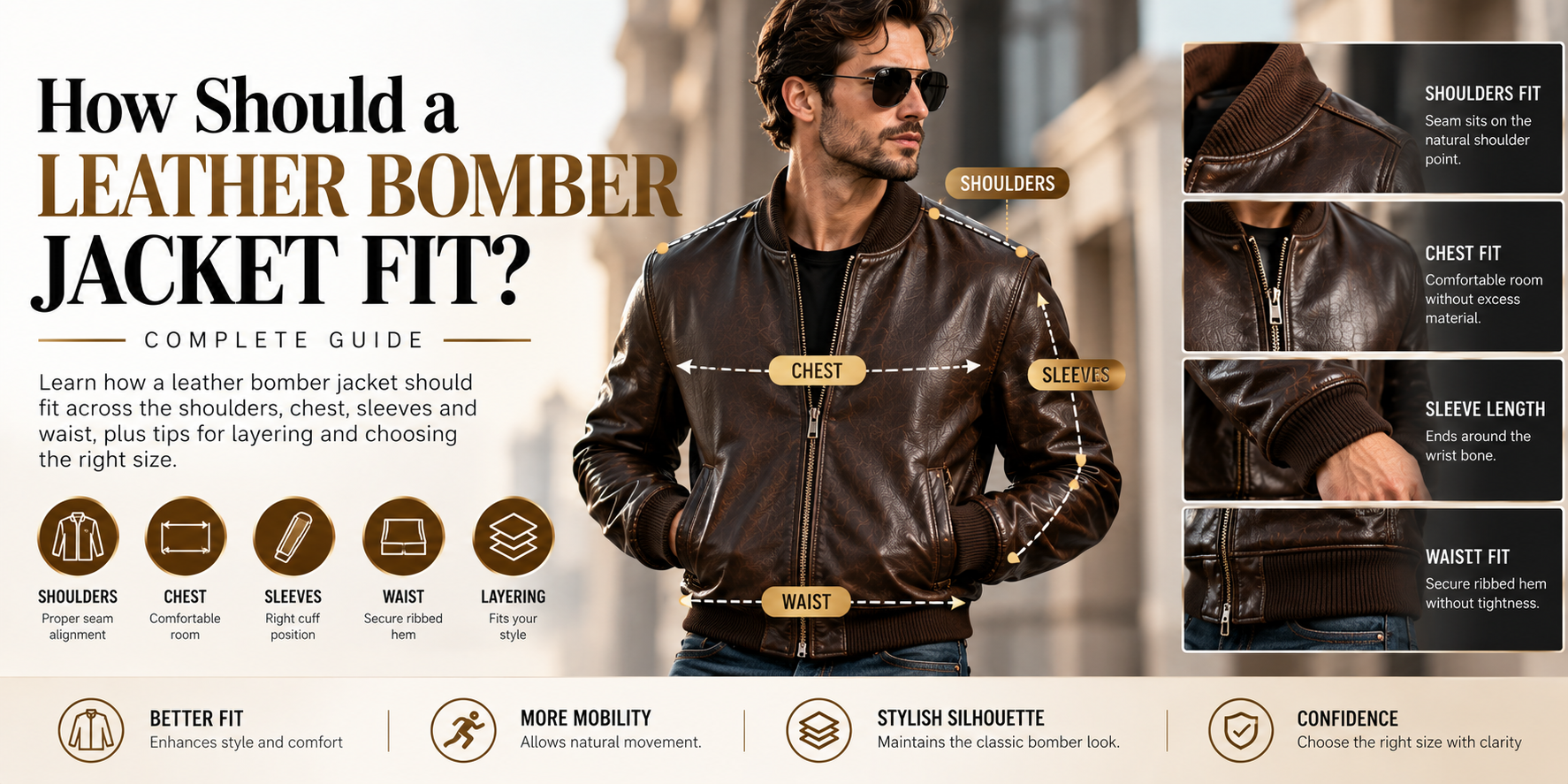
How Should a Leather Bomber Jacket Fit?
Learn how a leather bomber jacket should fit across the shoulders, chest, sleeves and waist, plus how layering and the ribbed hem affect the overall silhouette.
What Does a Well-Fitting Leather Bomber Look Like?
A well-fitting leather bomber jacket should feel comfortable through the shoulders and chest while maintaining the characteristic compact shape of a bomber jacket. The sleeves should allow natural arm movement, while the hem should sit securely without feeling excessively tight.
Unlike a long leather coat, a bomber jacket is designed around a shorter body and a defined waist area. That means the fit should be evaluated across several points rather than judged only by the chest measurement.
Your intended layering also matters. A jacket worn over a T-shirt may require a different amount of room than one intended for sweaters or heavier winter clothing.
Check These Areas Before Choosing Your Size
Shoulders
The shoulder seam should sit close to the natural shoulder point without extending noticeably beyond it.
Chest
The chest should provide enough room for comfortable movement without creating excessive loose material.
Sleeves
Sleeves should provide appropriate wrist coverage while allowing natural movement through the elbows.
Ribbed Hem
The hem should sit securely around the waist without creating uncomfortable pressure when sitting or moving.
How Should the Shoulders Fit?
Shoulder fit is one of the most important parts of a leather bomber jacket. The shoulder seam should generally align with the natural edge of your shoulder rather than sitting far beyond it.
Look for Natural Shoulder Alignment
If the seam sits substantially past the shoulder, the jacket can appear oversized even when the chest measurement is appropriate.
If the shoulder area feels restrictive or pulls when you move your arms forward, the jacket may not provide enough room for your intended use.
How Much Room Should a Leather Bomber Have in the Chest?
A bomber jacket should not compress the chest when zipped or fastened. At the same time, excessive room can remove the structured appearance that gives a bomber its distinctive silhouette.
Check the chest with the jacket closed, not only when wearing it open.
Reach forward and across your body to check whether the chest and upper back restrict movement.
Check the fit with the type of clothing you normally intend to wear underneath.
Strong horizontal pulling around the zipper area can indicate insufficient chest room.
How Long Should Leather Bomber Sleeves Be?
The sleeves should provide suitable wrist coverage without creating excessive material around the cuff. The exact visual position can vary depending on cuff construction and the jacket’s intended style.
When evaluating sleeve length, bend your arms and move them naturally. A sleeve that looks correct while standing still can feel different when the elbows are bent.
Check the Cuff, Not Just the Length
Ribbed cuffs, elasticated cuffs and other sleeve finishes can change how the sleeve sits around the wrist. Evaluate the entire cuff construction rather than focusing on one measurement alone.
How Should the Bottom of a Bomber Jacket Fit?
Secure Around the Waist — Not Uncomfortably Tight
The bottom ribbed hem should sit securely around the waist area and maintain the bomber’s compact shape. It should not create excessive pressure when you sit, bend or move.
Pay particular attention to the hem when wearing the jacket zipped. The fit can feel different once the front closure is fully fastened.
How to Tell If a Bomber Jacket Is Too Tight or Too Loose
Restricted Movement
Strong pulling across the chest, shoulders or upper back, together with restricted arm movement, can indicate that the jacket does not provide enough room.
Excessive Volume
Drooping shoulders, excessive chest material and a very loose waist can make the bomber lose its intended structured silhouette.
How Should a Bomber Fit With Different Layers?
Think about how you will actually wear the jacket before selecting your size. Leather bombers can be styled across different seasons, so the intended base layer matters.
T-Shirt
A close-fitting base layer generally requires less space through the chest and sleeves.
Shirt
Allow enough room for the shirt without creating excessive fabric bunching beneath the leather.
Sweater
A thicker sweater requires additional usable room through the chest, arms and body.
Use Your Measurements Instead of Guessing Your Size
Jacket sizing varies between manufacturers and patterns. Rather than assuming that your usual letter size will fit, compare your body measurements with the specific product’s size chart.
| Measurement | What to Check | Why It Matters |
|---|---|---|
| Chest | Measure around the fullest part. | Helps determine available room through the torso. |
| Shoulders | Compare shoulder width with the jacket chart. | Important for seam placement and mobility. |
| Sleeve | Measure from shoulder point toward the wrist. | Helps evaluate cuff and wrist coverage. |
| Waist | Consider the area where the bomber hem sits. | Particularly relevant for ribbed or elasticated hems. |
Leather Bomber Fit Mistakes to Avoid
Choosing a size based only on your usual T-shirt size.
Ignoring shoulder alignment because the chest feels comfortable.
Checking the jacket only while standing and never testing normal arm movement.
Forgetting to account for the sweater or other layers normally worn underneath.
Assuming that a very tight leather jacket will automatically become the correct size with wear.
A Good Bomber Fit Balances Structure and Movement
Focus on shoulder alignment, comfortable chest room, usable sleeve length and a secure but comfortable hem. Then consider the layers you normally wear and confirm your measurements against the manufacturer’s size chart.