


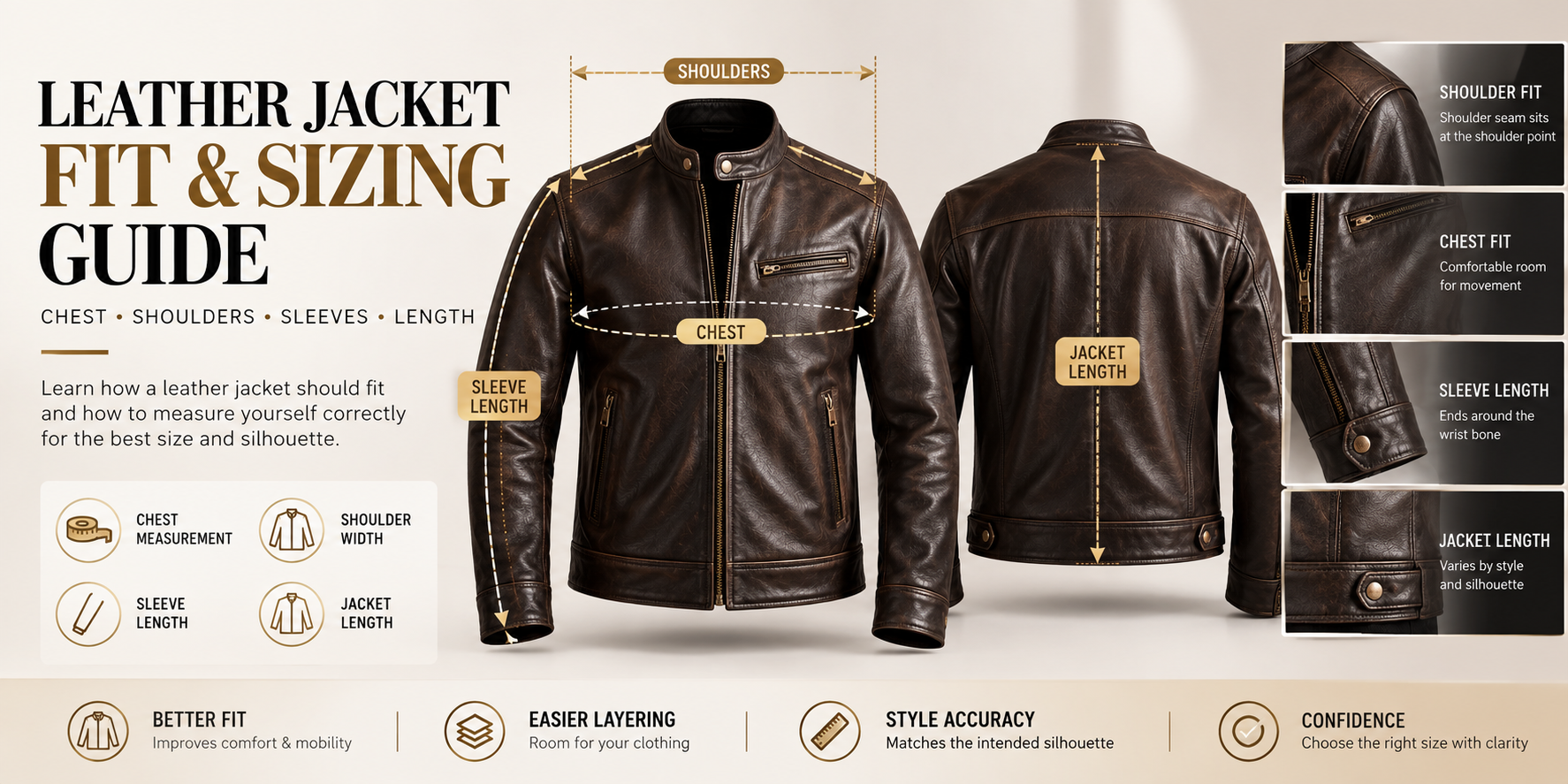
Leather Jacket Fit & Sizing Guide
Learn how a leather jacket should fit across the chest, shoulders, sleeves and body length — and how the correct fit changes depending on the jacket style and layering needs.
How Should a Leather Jacket Fit?
A properly fitted leather jacket should feel secure without restricting movement. The most important areas to evaluate are the shoulders, chest, sleeves and overall length.
Leather does not behave exactly like a lightweight fabric. Because of that, choosing a jacket based only on your usual clothing size can lead to problems with shoulder width, sleeve length or layering space.
Measuring before ordering gives you a much clearer starting point. Your measurements should then be compared with the specific jacket’s size chart.
Four Measurements That Matter Most
Chest
Measure around the fullest part of your chest, passing under the arms and across the shoulder blades.
Shoulders
Measure from one shoulder point to the other across the back.
Sleeve Length
Measure from the shoulder point to the wrist bone with your arm slightly bent.
Jacket Length
Consider where the jacket should end on your torso based on its intended silhouette and style.
Waist
Waist measurements can help evaluate body shape and available room, particularly with tapered silhouettes.
Back Length
Check the jacket’s back length against your preferred coverage and the intended style.
How to Measure Yourself Correctly
For the most useful measurements, stand naturally and keep the measuring tape level. Avoid pulling the tape excessively tight or leaving unnecessary slack.
Follow These Steps
Place the tape around the fullest point of the chest, under the arms and across the shoulder blades.
Measure from one shoulder point to the other across the back.
Start at the shoulder point and measure toward the wrist bone while keeping the arm slightly bent.
Write the measurements down before comparing them with the manufacturer’s size chart.
Getting the Shoulders Right
Shoulder fit is one of the most important parts of a leather jacket. If the shoulders are too narrow, reaching forward or moving your arms can create excessive tension across the upper back.
If the shoulders are excessively wide, the jacket can lose the intended silhouette and appear oversized.
Start With the Shoulders
A jacket that fits correctly at the shoulders provides a stronger foundation for evaluating the chest, sleeves and overall silhouette.
How Much Room Should You Have in the Chest?
The chest should provide enough room for natural movement and the layers you intend to wear underneath without making the jacket excessively loose.
Restricted Movement
Excessive tension around the chest and upper back can make reaching, driving or everyday movement uncomfortable.
Controlled Ease
The jacket sits close to the body while leaving enough room for comfortable movement and appropriate layering.
Lost Silhouette
Excess material can make the jacket appear oversized and change the silhouette intended by the design.
Plan for Your Use
If you regularly wear a sweater or mid-layer, allow enough space for that layer when selecting your size.
Where Should Leather Jacket Sleeves End?
Sleeve length should be considered alongside your posture and intended use. A sleeve that looks correct while standing may behave differently when you bend your arms or ride a motorcycle.
The reference measurement should generally run from the shoulder point to the wrist bone with the arm slightly bent.
Important: Do not judge sleeve length from the cuff alone. Consider the shoulder position, arm shape and intended movement when checking the complete sleeve fit.
How Long Should a Leather Jacket Be?
Jacket length depends heavily on the silhouette. A classic motorcycle jacket, bomber, aviator and longer fashion jacket will not necessarily finish at the same point on the body.
Usually designed around a practical riding-oriented silhouette with controlled torso coverage.
Often finishes around the waist or upper hip and may use a ribbed or structured hem.
Traditional aviator silhouettes can have a substantial body profile designed around colder-weather layering.
Length can vary considerably depending on whether the design is cropped, regular, tapered or extended.
How Fit Changes by Leather Jacket Style
| Style | Typical Fit Consideration | Layering |
|---|---|---|
| B-3 Shearling | The shearling lining adds interior volume. The fit should feel substantial without becoming restrictive. | Suitable for substantial winter layers when the jacket is designed with sufficient room. |
| A-2 / G-1 | Generally closer to a fitted silhouette with defined shoulder and body proportions. | Commonly suited to a sweater or light mid-layer. |
| Slim-Fit Aviator | More tapered through the body with less overall volume. | Better suited to lighter layers. |
| Bomber | Body volume and hem construction strongly influence the final silhouette. | Depends on the cut and available torso room. |
| Motorcycle Jacket | Shoulder, arm and torso mobility become particularly important when riding. | Choose layering room according to riding conditions. |
How Much Extra Room Should You Leave?
There is no universal amount of extra room that works for every leather jacket. The correct amount depends on the garment’s construction, intended silhouette and what you plan to wear underneath.
Light Layering
A closer fit may work when the jacket is primarily worn over a T-shirt or thin base layer.
Winter Layering
Additional room may be necessary when wearing a sweater, thermal layer or hoodie underneath.
Avoid Over-sizing
Buying significantly larger than necessary can alter the intended proportions and create excessive material.
Check Movement
Move your arms naturally and check the upper back and shoulders before deciding that the fit is correct.
Leather Jacket Sizing Mistakes to Avoid
Choosing your usual clothing size without checking the jacket’s actual size chart.
Ignoring shoulder width and focusing only on chest measurements.
Buying too short a sleeve and assuming the leather will compensate for the difference.
Forgetting to account for the sweater or mid-layer you normally wear.
Choosing an oversized jacket simply to gain additional layering room.
Judging fit only while standing instead of checking movement with the arms and shoulders.
Leather Jacket Fit Checklist
Check These Measurements First
Chest measurement is accurate and taken at the fullest point.
Shoulder width has been measured across the back.
Sleeve length has been measured from shoulder to wrist bone.
You know which layers you plan to wear underneath.
The measurements have been compared with the product’s specific size chart.
You have considered the intended jacket style before choosing the final size.
Leather Jacket Fit FAQs
How should a leather jacket fit?
What is the most important leather jacket measurement?
How do I measure my chest for a leather jacket?
How do I measure leather jacket sleeve length?
Should I size up in a leather jacket?
Should a leather jacket be tight at first?
How should a B-3 shearling jacket fit?
How should an A-2 or G-1 jacket fit?
Can I wear a sweater under a leather jacket?
Should I use my usual jacket size?
Measure First. Then Choose the Style.
The right leather jacket fit starts with accurate measurements. Chest, shoulders, sleeves and length all need to work together.
From there, consider the specific jacket style and how much layering you expect to use. Always compare your measurements with the product-specific size chart before ordering.